
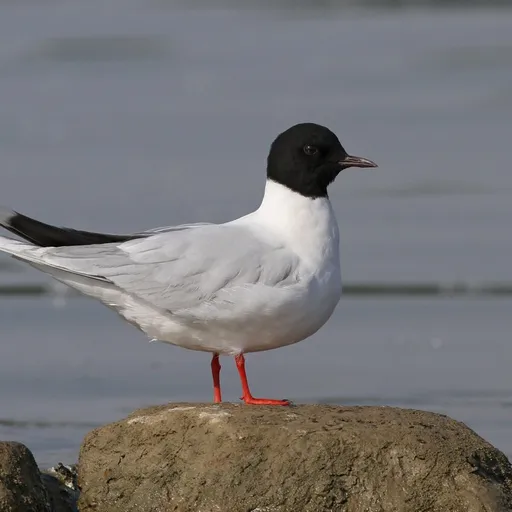
Little Gull
Hydrocoloeus minutus
Least Concern
Overview
The little gull (Hydrocoloeus minutus) is the smallest species of gull in the world and the only member of the monospecific genus Hydrocoloeus. Classified as Least Concern on the IUCN Red List, it is a migratory species primarily found in the Palearctic, with smaller populations in North America.
Identification
- Body length of 24 to 28 cm with a wingspan of 62 to 69 cm, making it the smallest gull in the world.
- Adults in breeding plumage feature a black hood, dark red bill, and bright red legs, sometimes with a rosy flush on the underside.
- Non-breeding adults display a black cap with an ear spot, white underparts, a black bill, and duller red legs.
- Juveniles have large blackish areas on the back and head, while first-winter birds retain a dark 'w' pattern on the upperwings.
Habitat
Breeding populations occupy dense vegetation with emergent or floating-leaved plants in shallow freshwater bodies, slow-moving rivers, marshes, and bogs, occasionally using coastal lagoons. During migration and winter, the species is predominantly coastal, favouring sand and mud substrates, river mouths, open sea, and sometimes sewage outfalls. Its range spans from northern Scandinavia and the eastern Baltic to eastern Siberia, with smaller colonies in the North American Great Lakes region.
Diet
Breeding birds are insectivorous, catching a variety of insects on the wing close to the water's surface. In winter, their diet shifts to being dominated by small fish and marine invertebrates.
Did you know?
In 2016, the little gull successfully nested for the first time in Great Britain at the RSPB reserve at Loch of Strathbeg in Aberdeenshire, though it did not breed there again in subsequent years.
Sources
- Wikipedia · CC BY-SA 4.0
- Wikidata · CC0 1.0