
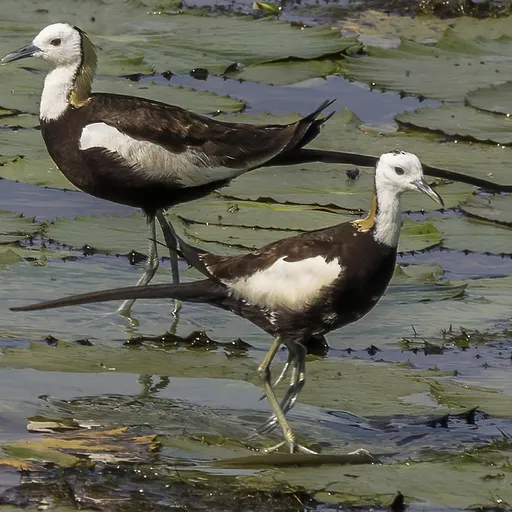
Pheasant-tailed Jacana
Hydrophasianus chirurgus
Least Concern
Overview
The pheasant-tailed jacana, Hydrophasianus chirurgus, is a distinctive waterbird belonging to the jacana family. It is notable for its elongated toes, which allow it to walk on floating vegetation, and is the only jacana species to migrate long distances and exhibit different breeding and non-breeding plumages.
Identification
- Breeding adults have a chocolate-brown body, a white face, and a black crown with white stripes separating the white throat from a golden-yellow nape.
- The wings are predominantly white but feature a black border on the outer primaries and secondaries, with scapulars that may appear green or purple.
- The bill is slender and bluish-black with a yellow tip during the breeding season, transitioning to dull brown with a yellowish base in non-breeding plumage.
- The legs are dark bluish-grey, and the bird possesses sharp, white carpal spurs on its wings that are longer in females.
Habitat
This species inhabits small to large lakes with sufficient floating vegetation across tropical Asia, ranging from Yemen to the Philippines. It is a resident in much of its range, including Sri Lanka and Taiwan, but northern populations from south China and the Himalayas migrate south to Southeast Asia and peninsular India seasonally.
Diet
The pheasant-tailed jacana primarily feeds on insects, molluscs, and other invertebrates picked from floating vegetation or the water's surface. It forages by walking on aquatic plants or swimming in the water, occasionally consuming filamentous algae, seeds, and plant material incidentally.
Did you know?
Females are polyandrous, laying up to ten clutches in a single season that are incubated and raised by different males in their harem. Males are responsible for the parental care, including moving the nest and eggs if disturbed, while females proceed to court new mates.
Sources
- Wikipedia · CC BY-SA 4.0
- Wikidata · CC0 1.0