
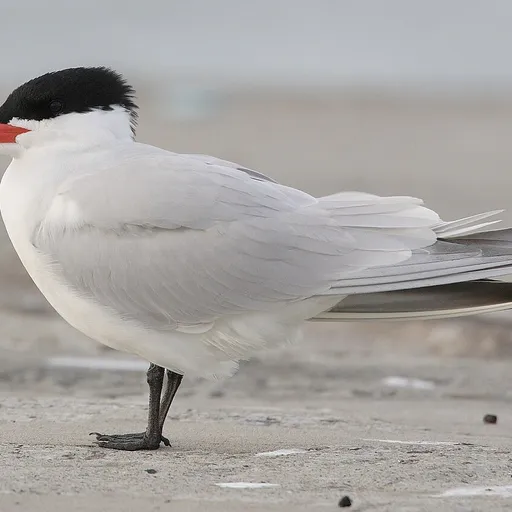
Caspian Tern
Hydroprogne caspia
Least Concern
Listen
XC826989 · Owen Camus · Arrondissement de la Rochelle (near Saint-Xandre), Charente-Maritime, Nouvelle-Aquitaine, France · CC0 1.0
Overview
The Caspian tern (Hydroprogne caspia) is the world's largest species of tern, characterized by a subcosmopolitan but scattered distribution. It is monotypic within its genus and has no accepted subspecies.
Identification
- Length of 48–60 cm with a wingspan of 127–145 cm and a weight of 530–782 g.
- White head, neck, belly, and tail, contrasted by a black cap that persists in winter with some white forehead streaking.
- Pale grey upper wings and back, with underwings that are pale but feature dark primary feathers and black wingtips visible from below.
- Long, thick red-orange bill with a small black tip and black legs.
- A loud, heron-like croak.
Habitat
Breeding habitats consist of large lakes and ocean coasts in North America, Europe, Asia, Africa, and Australasia. Migration patterns vary by region, with North American birds moving to southern coasts and the Old World tropics, while African and Australasian populations are largely resident. It is one of the species covered by the Agreement on the Conservation of African-Eurasian Migratory Waterbirds.
Diet
They feed mainly on fish by hovering high over the water and plunging to catch them, though they also occasionally consume large insects, the young and eggs of other birds, and rodents. These birds may travel up to 60 km from breeding colonies to forage and often fish in freshwater lakes as well as at sea.
Did you know?
In 2016, a pair bred successfully in northwestern Alaska, a location 600 km further north than any previous North American record, a shift attributed to global warming. The chicks display variable plumage patterns, which assists adults in identifying their own offspring when returning to the colony.
Sources
- Wikipedia · CC BY-SA 4.0
- Wikidata · CC0 1.0