
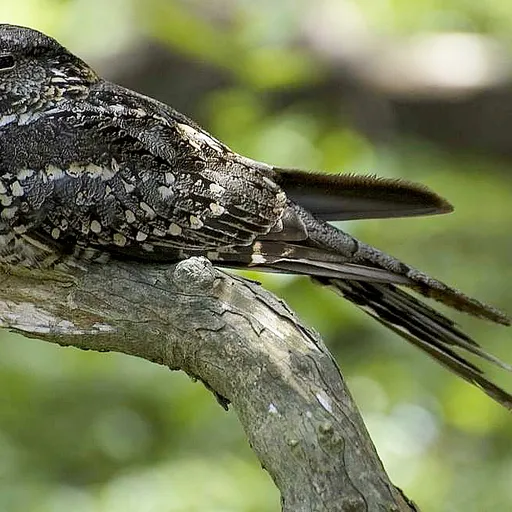
Scissor-tailed Nightjar
Hydropsalis torquata
Least Concern
Overview
The scissor-tailed nightjar (Hydropsalis torquata) is a species of nightjar in the family Caprimulgidae. It is distributed across much of eastern South America and is currently assessed as Least Concern by the IUCN.
Identification
- Males possess distinctive elongated outer tail feathers that are nearly twice their body length, reaching up to 66 cm total, whereas females have shorter outer tail feathers without white markings.
- Plumage features brown upperparts with greyish white speckles, a broad tawny collar on the hindneck, and buff underparts marked with narrow brown bars; wings lack the white band found in many other nightjars.
- Song consists of a prolonged sequence of 'tsips' lasting minutes, accompanied by an extremely high 'tsig' flight call and a low clucking sound.
- Size ranges from 25 to 30 cm excluding tail feathers, with males weighing 47.5 to 63 g and females 48 to 60 g.
Habitat
The species inhabits open and semi-open landscapes such as second growth, arid scrub, grasslands, acacia groves, and pastures, and is often seen along roads bordering sugar cane fields. Its range covers east central Peru across central Brazil, with an isolated population in Suriname, and extends from southern Peru through Bolivia, southern Brazil, Paraguay, northern and central Argentina, and Uruguay. Northern populations are generally resident, while southerly ones are thought to be migratory, spending the austral winter in southern Amazonia.
Did you know?
The genus name Hydropsalis combines the Ancient Greek 'hudro-' meaning 'water-' with 'psalis' meaning 'pair of scissors', while the specific epithet torquata comes from the Latin 'torquatus' meaning 'collared'.
Sources
- Wikipedia · CC BY-SA 4.0
- Wikidata · CC0 1.0