
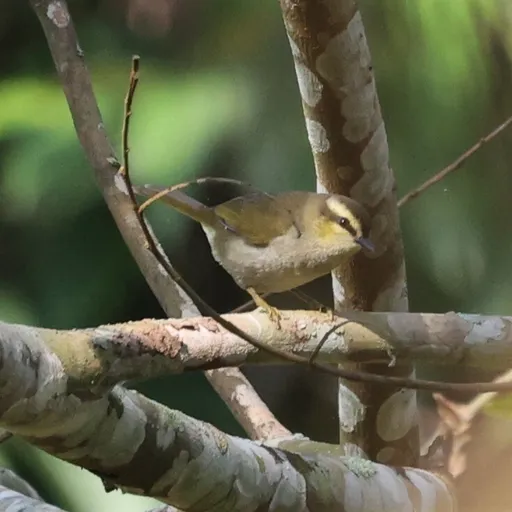
Green Hylia
Hylia prasina
Least Concern
Overview
The green hylia (Hylia prasina) is a small songbird that is widespread in tropical Africa, where it is classified as a species of Least Concern. As a monotypic genus, it inhabits the understory and mid-stratum of moist forests and has been assigned to the family Hyliidae. It is considered a forest generalist, capable of surviving in a wide range of environmental conditions within its range.
Identification
- Small bird weighing approximately 14 g, with a black bill and olive green feet.
- Dark brown irises and no noticeable difference in colour between the sexes, though males are generally larger.
- Two subspecies differ in underparts: H. p. prasina has an olive-green chin and throat with an olive-grey underbelly, while H. p. poensis has a white-grey throat and underbelly.
- Song is a recognisable, pure, two-note call, accompanied by common whistles or dry scolding rattles.
Habitat
Found throughout most of tropical Africa, the species is widespread in the Guineo-Congolian forest from western Gambia to western Kenya, with the subspecies H. p. poensis restricted to islands in the Gulf of Guinea. It prefers mostly intact, semideciduous moist forests, occurring at forest edges, gaps, and interiors among plants such as Elaeis guinensis and Celtis zenkeri. Liana and Scleria species provide suitable nesting materials and food sources within this habitat.
Diet
This species is a foliage-gleaning insectivore that forages in the canopy and forest understory, usually at a height of about 10 metres. Its diet consists of insects, ants, or butterflies found on the underside of leaves or amongst forest litter. Carbon source analysis indicates that its diet derives exclusively from C3 plants, typical of forest environments rather than farmland.
Did you know?
The green hylia was found to be infected with Plasmodium parahexamerium, a parasite that was previously thought to inhabit only New World hosts, making its presence in this Old World bird both interesting and concerning. Additionally, the bird’s narrow bandwidth songs can be lengthened and amplified by reverberations in dense vegetation, allowing it to defend territory or attract mates more effectively without expending extra energy.
Sources
- Wikipedia · CC BY-SA 4.0
- Wikidata · CC0 1.0