
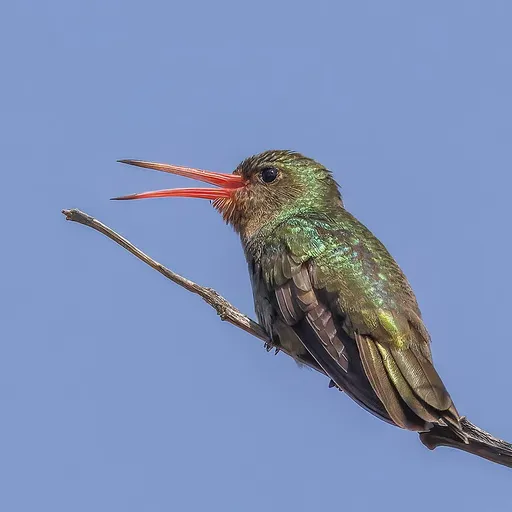
Gilded Sapphire
Hylocharis chrysura
Least Concern
Overview
The gilded sapphire, also known as the gilded hummingbird, is a species of hummingbird found in South America. It is a monotypic species that shares its genus with the rufous-throated sapphire and is currently classified as Least Concern by the IUCN due to its large range and increasing population.
Identification
- Length of 8 to 10 cm and a weight of 4 to 5 g.
- Adult males feature iridescent golden-green plumage with a pale rufous chin and a glittering golden-bronze tail, while females are duller with a grayish lower belly.
- Both sexes possess a medium-length, straight, coral red bill with a black tip.
- Song consists of a repeated high-pitched, cricket-like trill, and calls include a short dry rattle described as 'trrrt'.
Habitat
This species inhabits open landscapes such as savannah with scattered trees, forest edges, clearings, plantations, and gardens. It is most numerous at elevations between 400 and 800 m but can be found from 200 m up to 1,000 m and locally higher. Its range covers northeastern to south central Bolivia, essentially all of Paraguay and Uruguay, central and southeastern Brazil, and northern Argentina.
Diet
The gilded sapphire forages for nectar from a wide variety of native and introduced plants, shrubs, and trees at all levels of its habitat. It also catches insects by hawking from a perch and gleans spiders from webs.
Did you know?
The female builds a cup nest made of plant seed fibers and cobweb, often decorating the outside with lichen and bits of leaf. These nests are typically placed somewhat exposed on thin horizontal branches or forks 4 to 6 m above the ground, though occasionally as high as 10 m.
Sources
- Wikipedia · CC BY-SA 4.0
- Wikidata · CC0 1.0