
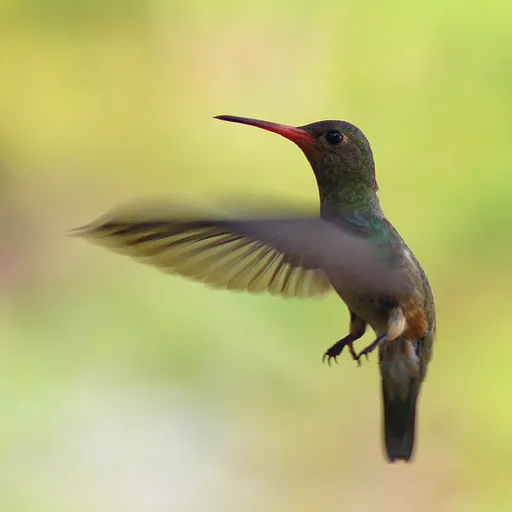
Rufous-throated Sapphire
Hylocharis sapphirina
Overview
The rufous-throated sapphire (Hylocharis sapphirina) is a small hummingbird found across various regions of South America, including Bolivia, Brazil, Colombia, Ecuador, the Guianas, Peru, and Venezuela. It belongs to the 'emeralds' group within the family Trochilidae and is noted for its iridescent plumage.
Identification
- Males measure 8.4 to 9.1 cm in length and possess a medium-length, straight bill that is coral red with a black tip, while females have bills with less red.
- Adult males feature dark green upperparts with coppery violet uppertail coverts, an iridescent violet-blue throat and breast, and a distinct rufous chin.
- Females display grayish underparts marked with large glittering blue-green spots on the throat and chest, along with a paler rufous chin.
- Vocalisations vary by region, including a high-pitched 'sping' in Venezuela, a drawn-out 'seeeeeee' in Amazonia, and a repeated short dry trill.
Habitat
This species inhabits semi-open to open landscapes such as lowland forest edges, savannas with scattered trees, rock outcrop clearings, and coffee plantations, most commonly between 200 and 500 m in elevation. Its range covers three separate areas in South America, extending from eastern Colombia and Venezuela through to northern Brazil, southern Ecuador, and parts of Bolivia and Paraguay.
Diet
The rufous-throated sapphire forages for nectar from epiphytes, shrubs, vines, and trees, typically feeding near the ground to the middle strata of the forest. It also consumes insects caught by hawking from a perch or gleaned from leaves and spiderwebs, with males aggressively defending feeding territories.
Did you know?
The genus name Hylocharis combines Ancient Greek words for 'woodland' or 'forest' and 'beauty', reflecting the species' aesthetic appeal in its natural habitat. Despite being considered common in much of its range, its status in Paraguay and Argentina remains hypothetical due to a lack of tangible photographic evidence.