
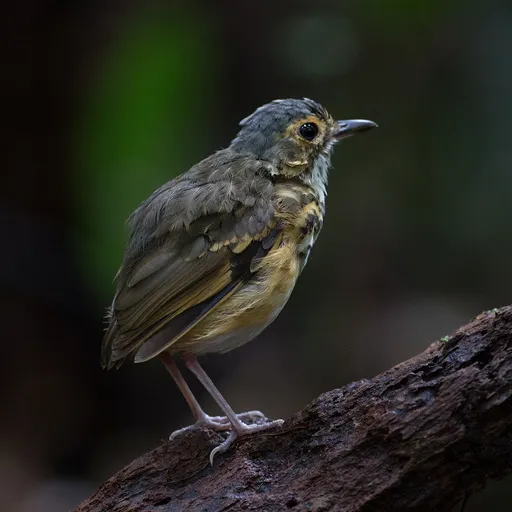
Spotted Antpitta
Hylopezus macularius
Least Concern
Overview
The spotted antpitta (Hylopezus macularius) is a small passerine bird in the family Grallariidae. It is currently classified as Least Concern on the IUCN Red List, though its population status varies significantly across its range.
Identification
- Length of approximately 14 cm with a weight of 43 to 53 g.
- Plumage features a wide white 'moustache' above a black stripe, a white throat with a black line descending from the bill, and underparts that are pale ochraceous or buffy-white with short black streaks on the breast.
- Distinctive orange-buff lores and eye-rings on nominate subspecies, accompanied by dark brown irises and a black upper bill with a pinkish lower mandible tipped in black.
- Song consists of six notes, transcribed as 'whoa-whoa-wok-whoa-wok-wok' in the nominate subspecies and 'hoor-hoor-hoor-hoor-ho-ho' in H. m. dilutis.
Habitat
The species inhabits the floor and undergrowth of mature terra firme and gallery forests. It is restricted to lowland areas, reaching only 300 m in Colombia and 500 m in Venezuela. Its range spans eastern Bolívar state in Venezuela, the Guianas, northeastern Brazil north of the Amazon and east of the Branco and Negro rivers, as well as parts of southern Venezuela, southeastern Colombia, northeastern Peru, and the Negro River basin in northwestern Brazil.
Diet
The spotted antpitta feeds primarily on insects, although its full dietary composition is not detailed. It forages exclusively on the ground, probing and flicking leaf litter and soil to locate prey, and is usually observed singly or in pairs.
Did you know?
Nests are constructed on top of horizontal palm fronds positioned 75 to 82 cm above the ground. The outer structure of the nest is built from twigs and dead leaves surrounding a shallow inner cup made of finer materials such as rootlets or thin woody leaf stems.
Sources
- Wikipedia · CC BY-SA 4.0
- Wikidata · CC0 1.0