
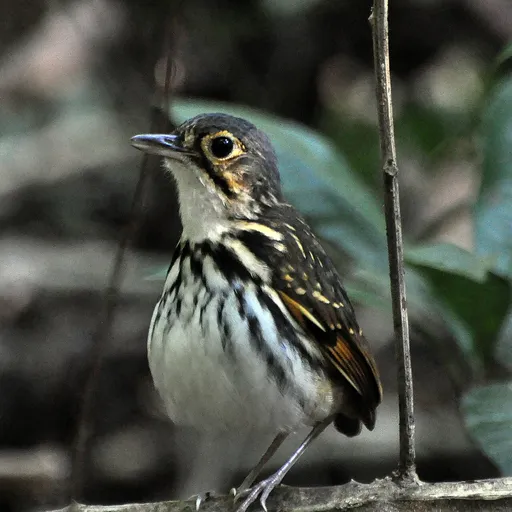
Streak-chested Antpitta
Hylopezus perspicillatus
Least Concern
Listen
XC248248 · Niels Krabbe · Esmeraldas: left bank Rio Santiago: Playa del Oro, Ecuador · CC BY-SA 4.0
Overview
The streak-chested antpitta, also known as the spectacled antpitta, is a small bird in the family Grallariidae found in lowland evergreen forests across parts of Central and South America. Currently classified as Least Concern by the IUCN, this year-round resident exhibits a generally stable status despite a believed decreasing population.
Identification
- Size: 12.5 to 14 cm long and 40 to 54 g in weight.
- Plumage: Yellow loral patch and wide yellow eye ring; gray crown and nape; brown upperparts with yellowish streaks; underparts white to buffy with distinct black streaks across the breast and flanks.
- Bill and Legs: Slate gray maxilla, pale gray to pink mandible, and pale gray legs and feet.
- Song: A series of 7–9 whistled notes that gradually fall in pitch and volume, described as "poh, po-po-po-po-po-po-peu-peu-peu"; alarm calls consist of a whistled "keeuw" followed by a decelerating rattle.
Habitat
Found in Colombia, Costa Rica, Ecuador, Honduras, Nicaragua, and Panama, the species inhabits lowland evergreen forest in tropical and lower subtropical zones. It occurs at elevations up to 1,250 m, though this varies by region, reaching as low as 200 m in Honduras.
Diet
Primarily feeds on terrestrial arthropods, with small lizards and frogs making up a minor component of its diet. Foraging is mostly terrestrial, though it occasionally reaches up to 4 m above the ground, involving hopping or running across the forest floor to toss aside leaf litter.
Did you know?
The species was known by the English name "spectacled antpitta" until the late twentieth century, a moniker likely derived from its distinctive wide yellow eyering. Despite having a very large range and a population of at least 50,000 mature individuals, it remains vulnerable to forest fragmentation like other understory insectivorous species.
Sources
- Wikipedia · CC BY-SA 4.0
- Wikidata · CC0 1.0