
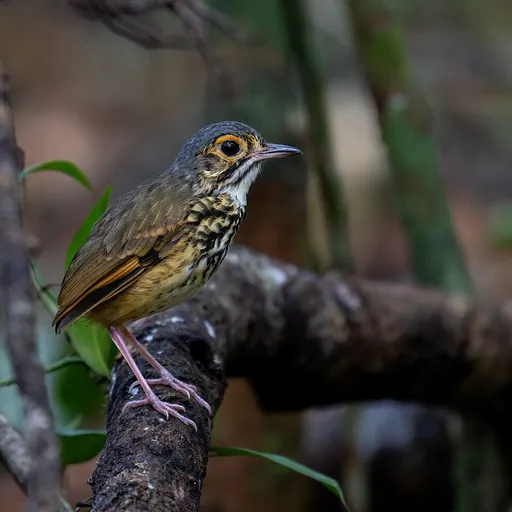
Alta Floresta Antpitta
Hylopezus whittakeri
Overview
The Alta Floresta antpitta (Hylopezus whittakeri) is a small bird species in the family Grallariidae that is endemic to Brazil. Described for science in 2012 as distinct from the spotted antpitta, it remains a subspecies under the BirdLife International taxonomy.
Identification
- Approximately 14 cm long with a weight of 40 to 47 g, featuring olive-brown upperparts and creamy white underparts with buffy-cinnamon washes on the flanks.
- Distinctive head markings include buffy-orange lores and eye-ring separated by a thin black crescent, speckled ear coverts, and a white 'moustache' with a black stripe beneath.
- Pale purple-pink legs and feet, combined with a dark brown iris and a bill that has a gray-black upper half and pinkish lower half.
- Song consists of five whistled notes (rarely four or six) with identical shapes, where the second and third notes are separated by an unusually long interval.
Habitat
Endemic to the Amazon Basin of south-central Brazil, specifically south of the Amazon between the Madeira and Xingu rivers across the states of Pará, Amazonas, Rondônia, and Mato Grosso. The species inhabits humid lowland terra firme forest, favouring swampy or flooded areas and watercourses, with drier transitional forest present at the southern edge of its range.
Diet
Specific dietary and foraging habits are not documented, but it is assumed to consume invertebrates and small vertebrates, similar to other members of its genus.
Did you know?
The species was only described in 2012 after taxonomic revisions, having previously been mistaken for Snethlage's antpitta despite being recognised as distinct by other authorities. Its breeding biology remains largely unknown, with the only confirmed nest discovered in 2009 when the sitting bird was misidentified as a black-spotted bare-eye.