
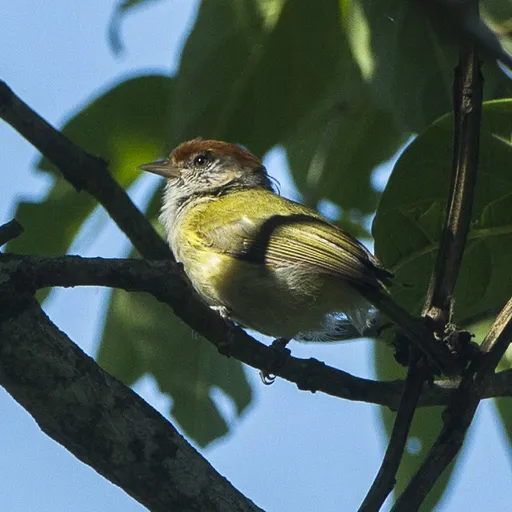
Grey-eyed Greenlet
Hylophilus amaurocephalus
Least Concern
Overview
The grey-eyed greenlet, Hylophilus amaurocephalus, is a species of bird in the family Vireonidae. It is primarily found in northeastern Brazil, with possibly unconfirmed records in northern Bolivia. The species is currently listed as Least Concern on the IUCN Red List.
Identification
- Length of 12.5 to 13 cm with identical plumage in both sexes.
- Chestnut-brown forehead and crown contrasting with a pale grayish supercilium and mottled gray-white ear coverts.
- Underparts are brownish gray with yellowish flanks, a dull whitish chin, and a dull grayish throat.
- Song consists of a high, rather harsh 'see-see or te Teé-te Teé-te Teé' with many variations.
Habitat
This species inhabits caatinga, scrublands, brushy pastures, woodlands, and forest edges across an elevation range from near sea level to 1,800 m. Its distribution covers northeastern Brazil from Piauí and Ceará south to São Paulo state, with unconfirmed presence in the Beni Department of Bolivia. It is considered a sedentary year-round resident that adapts well to substantially modified habitats such as regenerating pastures.
Diet
The grey-eyed greenlet feeds on arthropods and includes many fruits in its diet. It forages fairly low in the forest, usually between 1 and 10 m above the ground. Foraging is typically done in pairs or family groups, and the species regularly joins mixed-species feeding flocks.
Did you know?
The one described nest is a cup made from moss and plant down, suspended in a forked twig amid dense vines approximately 5 m above the ground. Although the breeding season includes January, details regarding clutch size, incubation periods, and parental care remain unknown.
Sources
- Wikipedia · CC BY-SA 4.0
- Wikidata · CC0 1.0