
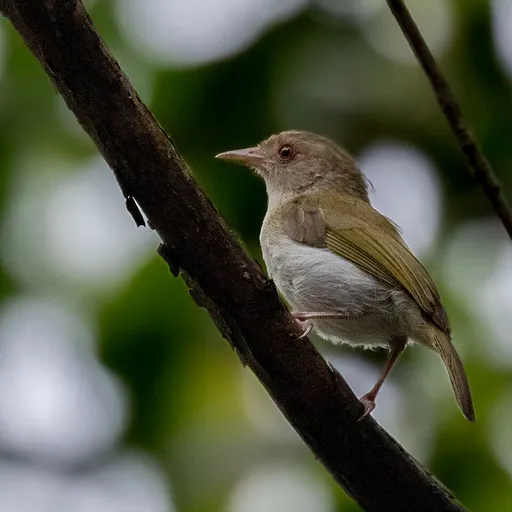
Brown-headed Greenlet
Hylophilus brunneiceps
Least Concern
Overview
The brown-headed greenlet (Hylophilus brunneiceps) is a small bird in the family Vireonidae found in parts of South America. It is currently assessed as Least Concern by the IUCN, with a stable population and no immediate threats identified.
Identification
- Adults possess a brown or dull sepia crown with a slight yellowish wash, dull brownish face, and olive-green upperparts and tail.
- The throat and upper breast are dirty white with an olive-buff tinge, while the lower breast and belly are gray-white with yellowish flanks and pale greenish yellow vents.
- Males and females are identical in plumage, and the bird measures approximately 11 to 12 cm in length, weighing between 8 and 11.5 g.
- It features a gray or whitish iris, a brown maxilla and pinkish mandible, along with pink legs and feet.
- The song is described as a high, warbling 'weet-oh-weeréet', while agitated birds emit twitters followed by soft notes and a louder, descending series.
Habitat
The species ranges from eastern Colombia across southern Venezuela's Amazonas state and into southeast Brazil to the Negro River near Manaus. It inhabits scrubby low-stature forest on sandy soils, woodlands in savanna, blackwater river areas, and the edges of várzea forest, reaching elevations of up to 400 m in Brazil and Colombia.
Diet
The diet includes caterpillars and adult insects, though it has not been fully detailed. The bird forages in pairs, family groups, or mixed-species flocks, typically between 5 and 12 m above the ground. It actively forages among leaves, sometimes hanging upside down or hovering briefly to capture food from the undersides of leaves.
Did you know?
This sedentary resident occasionally hangs upside down or briefly hovers to capture insects from the undersides of leaves, behaviours that distinguish its foraging technique.
Sources
- Wikipedia · CC BY-SA 4.0
- Wikidata · CC0 1.0