
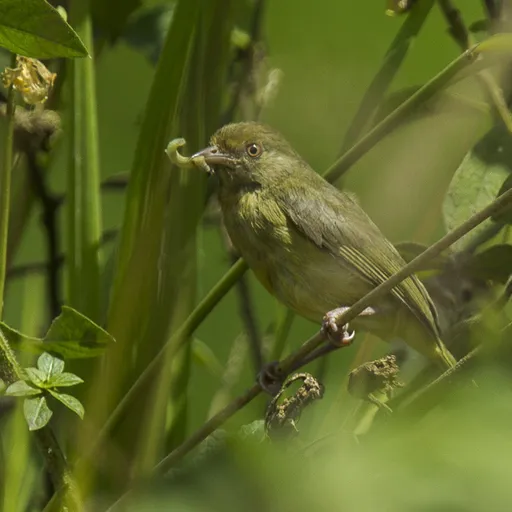
Olivaceous Greenlet
Hylophilus olivaceus
Least Concern
Listen
XC242795 · Niels Krabbe · Napo: km 44 Narupa-Coca road, Ecuador · CC BY-SA 4.0
Overview
The olivaceous greenlet (Hylophilus olivaceus) is a small bird in the family Vireonidae found in Ecuador and Peru. It is currently listed as Least Concern on the IUCN Red List, with an estimated stable population of at least 50,000 mature individuals.
Identification
- Size of 12 cm (4.7 in) in length, weighing between 11 and 13 g.
- Dull olive-green upperparts, wings, and tail, with a yellowish olive forehead.
- Underparts are yellowish olive, slightly lighter on the chin and brighter yellow on the belly.
- Features a whitish iris, a dull pink or brownish pink bill, and brownish pink legs.
- Song consists of a distinctive and loud series of up to 10-12 musical 'suwee' or 'peer' notes.
Habitat
This species inhabits the edges and shrubby clearings of forest, as well as mature secondary forest, on the eastern slope of the Andes. In Ecuador, its range extends from Napo Province south almost to the Peruvian border between 600 and 1,450 m, while in Peru it occurs in southern Amazonas, northern San Martín, southern Huánuco, and northern Junín departments at elevations between 1,000 and 1,700 m, locally down to 750 m.
Diet
The diet of the olivaceous greenlet is not known. It typically forages singly or in pairs and only occasionally joins mixed-species feeding flocks.
Did you know?
Although its diet remains a mystery, a pair was observed feeding a newly fledged young in June in Peru, marking the only known record of its breeding behaviour.
Sources
- Wikipedia · CC BY-SA 4.0
- Wikidata · CC0 1.0