
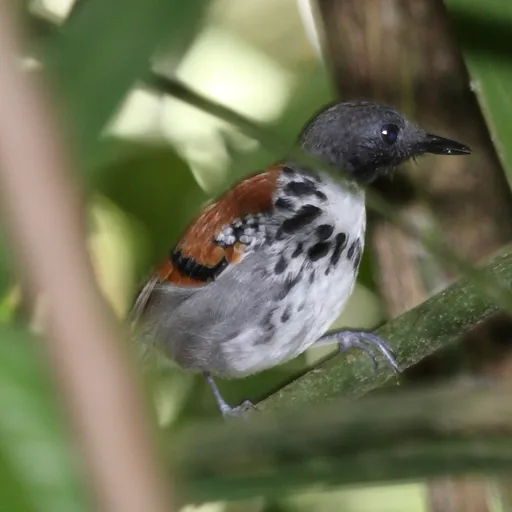
Spotted Antbird
Hylophylax naevioides
Least Concern
Listen
XC251016 · Niels Krabbe · Esmeraldas: Canandé ridge trail, Ecuador · CC BY-SA 4.0
Overview
The spotted antbird is a species of bird in the family Thamnophilidae, commonly known as the typical antbirds. It is classified as Least Concern on the IUCN Red List, though its population is believed to be decreasing.
Identification
- 10 to 12 cm long and weighs 15 to 19.5 g.
- Males have a chestnut back with a hidden white and chestnut patch, black cheeks and throat, and a white underpart with a necklace of heavy black spots across the breast.
- Females have a dull brown crown, blackish slate head sides, and irregular olive or dull gray spots on the breast.
- Song consists of repeated syllables of a peeee whistle followed by a short ti note, such as peeeeeti-peeeti-peeeti.
Habitat
Found in humid lowland forest, both primary and mature secondary, on the Caribbean and Pacific slopes of Central America and in northern and western Colombia and Ecuador. It favours thick undergrowth in the forest interior and reaches elevations of up to 1,000 m in Central America and Colombia, but only 300 m in Ecuador.
Diet
Feeds primarily on a wide variety of insects, including crickets, cockroaches, moths, sowbugs, ants, and beetles, as well as significant amounts of other arthropods plus lizards and frogs. It is a facultative army ant follower, catching about half of its prey as it flees the swarms, and forages as individuals or pairs within about 2 m of the ground.
Did you know?
The spotted antbird builds its open cup nest mostly from fungal rhizomorphs, often making it appear like a pile of debris attached to branches within 2 m of the ground.
Sources
- Wikipedia · CC BY-SA 4.0
- Wikidata · CC0 1.0