
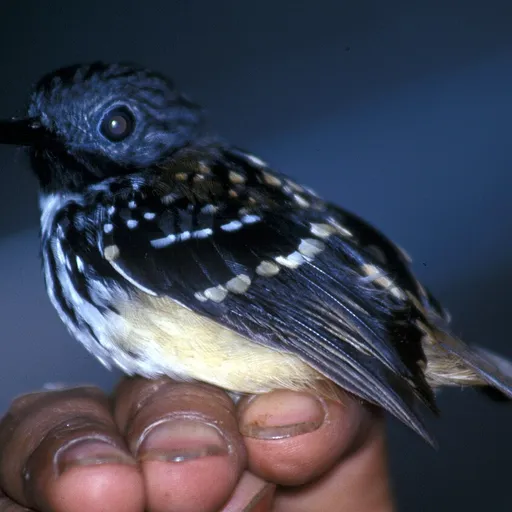
Spot-backed Antbird
Hylophylax naevius
Least Concern
Listen
XC249965 · Niels Krabbe · Morona-Santiago: e-slope Cord. de Cutucú: Uuntsuants, Ecuador · CC BY-SA 4.0
Overview
The spot-backed antbird (Hylophylax naevius) is a small bird in the family Thamnophilidae, known for its spotted back and association with humid forests across South America. It is classified as a species of Least Concern on the IUCN Red List due to its large range and stable population.
Identification
- Size: Small, measuring 10.5 to 11.5 cm in length.
- Plumage: Upperparts are mostly dark yellowish brown, with the centre of the back black and pale buff spots, and a white patch between the scapulars.
- Underparts: Mostly white or buff with heavy black spots across the breast and sides.
- Song: A long series of doublets, described in Ecuador as a fast, high-pitched, wheezy 'wur, weépur-weépur' and in Brazil as a high, slightly descending series of 'tjuwit-' notes.
Habitat
Found in humid evergreen forest in the lowlands and Andean foothills of Bolivia, Brazil, Colombia, Ecuador, French Guiana, Guyana, Peru, Suriname, and Venezuela. It favours the forest understorey, particularly near openings caused by fallen trees and along watercourses, typically below 1,300 m in elevation.
Diet
Feeds primarily on a wide variety of insects and spiders, acting as a facultative army ant follower. It forages as individuals, pairs, or small family groups within about 3 m of the ground, hopping among branches and taking prey with sallies from a perch to the ground.
Did you know?
Although the species is named for its spotted back, its specific epithet naevius derives from the Latin for 'spotted', a nod to its most distinctive field mark. Its nest is a cup suspended from a branch fork near the ground, often partially or fully concealed by hanging leaves.
Sources
- Wikipedia · CC BY-SA 4.0
- Wikidata · CC0 1.0