
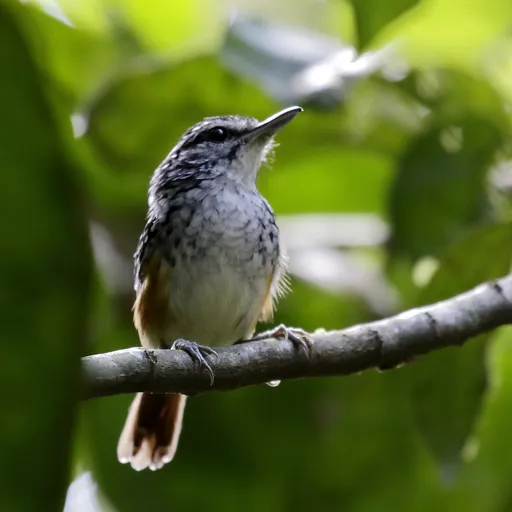
Peruvian Warbling Antbird
Hypocnemis peruviana
Least Concern
Listen
XC248893 · Niels Krabbe · Napo: Payamino, Loreto-Coca road, Ecuador · CC BY-SA 4.0
Overview
The Peruvian warbling antbird (Hypocnemis peruviana) is a species of bird in the family Thamnophilidae, commonly known as the typical antbirds. It is found in Bolivia, Brazil, Colombia, Ecuador, and Peru and is classified as Least Concern by the IUCN.
Identification
- Length of 11 to 12 cm with a rufous rump and deep rufous flanks and undertail coverts.
- Males display a black crown with a white central streak, a white supercilium, and a speckled black and white face, while females share the pattern but with dusky and buff upperparts.
- Song is described as raspy and almost snarling rather than warbling, sounding like 'peér, peer-peer-peer-peer-pur-pur-pyur' with a descending effect.
Habitat
Primarily inhabits the edges and gaps in várzea and igapó evergreen forest, mature secondary forest, and forest along watercourses in more open landscapes. It also occupies terra firme forest and somewhat open woodlands to a lesser extent. Its range spans eastern Peru, northern Bolivia, southwestern Amazonian Brazil, southern Colombia, eastern Ecuador, and northeastern Peru.
Diet
Feeds primarily on insects and spiders, typically foraging alone, in pairs, or in family groups within dense vegetation such as vine tangles, understorey shrubs, bamboo thickets, and epiphyte clusters. Prey is taken by reaching or lunging from a perch, making short sallies to overhanging vegetation, and by regularly following army ant swarms while deferring to obligate ant followers.
Did you know?
Despite its common name, the male's song is not at all warbling, but rather a raspy, almost snarling sound. The usual clutch consists of two eggs that are pinkish with purple streaks and spots.
Sources
- Wikipedia · CC BY-SA 4.0
- Wikidata · CC0 1.0