
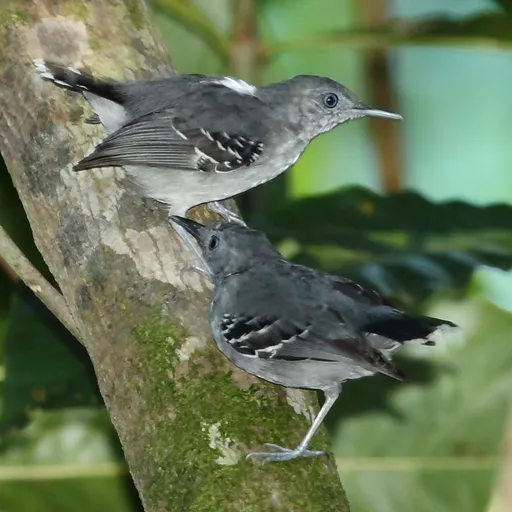
Band-tailed Antbird
Hypocnemoides maculicauda
Least Concern
Overview
The band-tailed antbird (Hypocnemoides maculicauda) is a species of bird in the family Thamnophilidae, commonly known as typical antbirds. It is found in Bolivia, Brazil, Colombia, and Peru, where it is considered to be of Least Concern by the IUCN.
Identification
- Approximately 12 cm (4.7 in) in length and weighing between 11.5 and 14.5 g (0.41 to 0.51 oz).
- Adult males feature leaden gray upperparts, a black throat, and underparts that are paler gray with a white belly.
- Adult females share the leaden upperparts but have white throats and underparts with gray-edged breast feathers.
- Both sexes possess gray irises and blue-gray legs, while males have all-black bills and females have black maxillae with gray mandibles.
Habitat
The band-tailed antbird inhabits lowland evergreen forest, predominantly in várzea forest along larger rivers, smaller watercourses, and lake edges. It favors low vegetation that overhangs water. Its range extends across the Amazon Basin from eastern Peru through northern Bolivia and central Brazil to the Atlantic, with recent records also indicating a presence in extreme southern Colombia.
Diet
The bird's diet consists mostly of insects, though specific details remain limited. Pairs and family groups forage on the ground and up to 4 m above it, almost always near or over water. They actively hop through vine tangles and brush, capturing prey by gleaning, reaching, and taking short sallies from perches, while occasionally attending army ant swarms.
Did you know?
Its vocalisation is distinctive, described as an accelerating series of rising, modulated whistles followed by an abruptly decelerating series of rising burry notes.
Sources
- Wikipedia · CC BY-SA 4.0
- Wikidata · CC0 1.0