
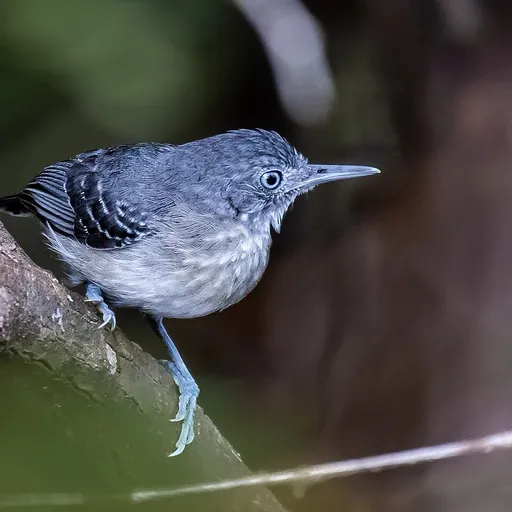
Black-chinned Antbird
Hypocnemoides melanopogon
Least Concern
Overview
The black-chinned antbird (Hypocnemoides melanopogon) is a small species of bird in the family Thamnophilidae, commonly known as the typical antbirds. It is distributed across several countries in South America and is currently assessed as being of Least Concern by the IUCN.
Identification
- Males possess leaden gray upperparts, a distinct black throat, and underparts that are a paler gray with a grayish white belly.
- Females share the leaden upperparts but have a whitish throat speckled with black and gray, along with a breast mottled with gray, white, and an olive gray tinge.
- Males have a solid black bill, whereas females have a black upper mandible and a gray lower mandible.
- The song consists of an accelerating, rising series of modulated whistles that descend slightly at the end with buzzy notes, or a series of high, accentuated notes that accelerate and bounce down.
Habitat
Found across Brazil, Colombia, Ecuador, French Guiana, Guyana, Peru, Suriname, and Venezuela, this species inhabits lowland evergreen forest. It is almost always located in várzea forest along larger rivers, smaller watercourses, and lake edges, favouring low vegetation that overhangs water up to elevations of 500 m in Colombia.
Diet
Although its diet has not been detailed, the black-chinned antbird is known to eat mostly insects and spiders. Pairs and family groups forage on the ground and up to 2 m above it, actively hopping through vine tangles and brush near water. They capture prey by gleaning, reaching, and making short sallies from a perch, occasionally attending army ant swarms.
Did you know?
The black-chinned antbird is closely related to the band-tailed antbird, yet some authors argue that the reasons for treating them as separate species are weak. Additionally, its breeding season appears to include at least March to July, though the exact details of parental care and fledging times remain unknown.
Sources
- Wikipedia · CC BY-SA 4.0
- Wikidata · CC0 1.0