
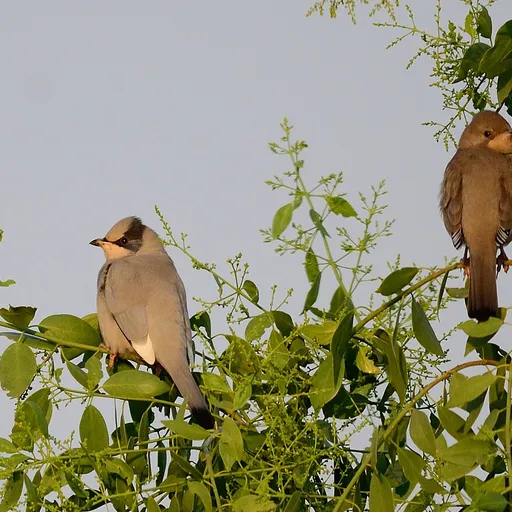
Grey Hypocolius
Hypocolius ampelinus
Least Concern
Overview
The grey hypocolius (Hypocolius ampelinus) is a small passerine bird and the sole member of the family Hypocoliidae. This slender, long-tailed species is found across dry semi-desert regions of northern Africa, Arabia, and parts of Asia. It is evaluated as a species of Least Concern by the IUCN Red List due to its large range.
Identification
- Slim body with a long tail, slight crest, and thick, short, hook-tipped bill; head feathers are raised when the bird is excited.
- Uniform grey or brownish-grey, soft, satiny plumage; males feature a black triangular mask around the eyes.
- White-tipped black primary wing feathers and a black terminal band on the tail.
- Adults measure approximately 19–21 cm in length with short, sturdy, coarse-scaled tarsus.
- Most common call consists of squealing descending notes or 'kleeeu' whistles, accompanied by occasional scolding chirps.
Habitat
Found in woodland and scrub within arid and semi-arid regions, particularly river valleys near deserts, as well as irrigated cultivated areas with trees, coastal zones, palm groves, and gardens. It breeds primarily in the Middle East, including Iraq, Iran, Afghanistan, and Pakistan, while wintering near the Red Sea and Persian Gulf coasts of Arabia, including Bahrain. The species is a regular winter visitor to western India and a vagrant to Turkey, Israel, Egypt, and Oman.
Diet
The bird forages quietly and methodically in foliage, clusters of trees, palm groves, and orchards, predominantly taking fruit and berries such as Salvadora persica, dates, mulberries, jujubes, and figs. It also consumes insects caught on the ground or in flight, and readily eats fallen fruit such as dates. In captivity, they have been observed taking bread readily.
Did you know?
The grey hypocolius belongs to a family of its own and was previously thought to be related to bulbuls or shrikes before molecular studies linked it to waxwings and the extinct Hawaiian honeyeaters. Because of this monotypic family status, it is highly sought after by birdwatchers.
Sources
- Wikipedia · CC BY-SA 4.0
- Wikidata · CC0 1.0