
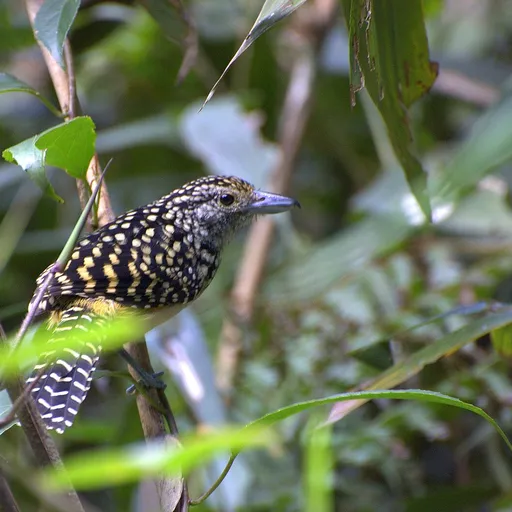
Spot-backed Antshrike
Hypoedaleus guttatus
Least Concern
Listen
XC633299 · Capovilla Pablo H · Cataratas Argentinas,Sendero Macuco, Parque Nacional Iguazú, Misiones, Argentina · CC BY-SA 4.0
Overview
The Hypoedaleus guttatus is a species of bird belonging to the family Thamnophilidae, commonly known as the typical antbirds. It is the sole member of its genus and is found across parts of South America, specifically in Argentina, Brazil, and Paraguay.
Identification
- A large antbird measuring 20 to 21 cm in length with slight sexual dimorphism.
- Features a short, heavy, gray bill with a distinct hook at the end, resembling that of true shrikes.
- Males possess a black crown, nape, and upperparts spotted with white, a brownish-black tail with white bars, white throat and breast, and pale gray sides.
- Females resemble males but display buff spots on their upperparts and more extensive brownish yellow on their underparts.
- The song is a "very high, slow, at first rising then descending, shivering rattle" lasting four or five seconds, accompanied by calls such as a long, downward-inflected whistle.
Habitat
Found in the Atlantic Forest from eastern Brazil south to northern Rio Grande do Sul, extending through eastern Paraguay and into northeastern Argentina's Misiones Province. It inhabits the subcanopy and canopy of lowland evergreen forest, ranging in elevation from sea level to approximately 900 m. The species almost exclusively occupies wetter areas characterised by dense vines and other vegetation.
Diet
Feeds on a variety of insects and other arthropods, as well as snails and possibly small vertebrates such as tree-frogs and lizards. It usually forages in pairs between 8 and 15 m above the ground, hopping sluggishly through dense vines to glean prey from leaves, stems, and branches, particularly on bromeliads and epiphytic ferns. It has also been observed following army ant swarms to capture disturbed prey.
Did you know?
Its eggs are white adorned with lilac dots and larger blackish spots. The genus name Hypoedaleus is derived from the Ancient Greek word for "somewhat swollen".
Sources
- Wikipedia · CC BY-SA 4.0
- Wikidata · CC0 1.0