
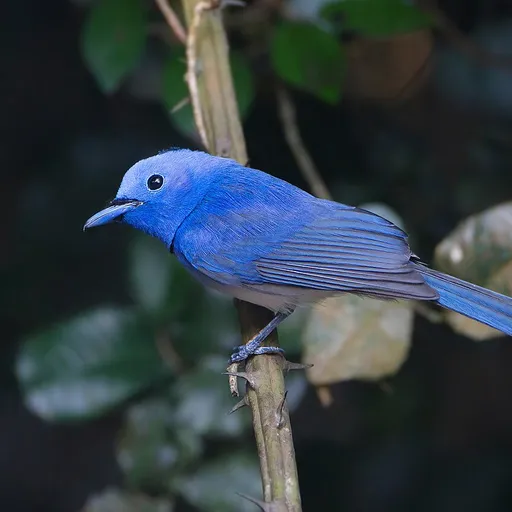
Black-naped Monarch
Hypothymis azurea
Least Concern
Listen
XC1175250 · Untung Sarmawi · Mamis, Mbeliling, West Manggarai Regency, East Nusa Tenggara, Indonesia · CC BY 4.0
Overview
The Hypothymis azurea is a passerine bird in the monarch flycatcher family found across tropical southern Asia. It is classified as Least Concern by the IUCN Red List. This sexually dimorphic species ranges from Iran to the Philippines and usually inhabits thick, well-wooded habitats.
Identification
- Males are roughly 16 cm long, predominantly pale azure blue with a whitish lower belly, a distinctive black nape, and a narrow black gorget.
- Females appear duller with grey-brown wings and backs, lacking the black head markings seen in males.
- When perched, the bird sits very upright like a shrike, and when alarmed, it raises its nape feathers into a pointed crest.
- Its call is described as a sharp, abrupt 'skrip', similar to that of the Asian paradise flycatcher.
Habitat
Found across tropical southern Asia from Iran and Sri Lanka east to Indonesia and the Philippines, this species typically resides in thick forests and other well-wooded habitats. Although largely resident, local seasonal movements occur, and the birds are active in the understory of forest canopies.
Diet
The black-naped monarch is insectivorous and frequently hunts by flycatching. In tropical forest environments, pairs often participate in mixed-species foraging flocks, where they can be significant members.
Did you know?
The cup nest is lined with spider-egg cases and fungi, including species of the genus Marasmius, which are known to produce antibiotics that may protect the young from infection. Additionally, the webs of large spiders such as Nephila maculata have been known to trap the birds.
Sources
- Wikipedia · CC BY-SA 4.0
- Wikidata · CC0 1.0