
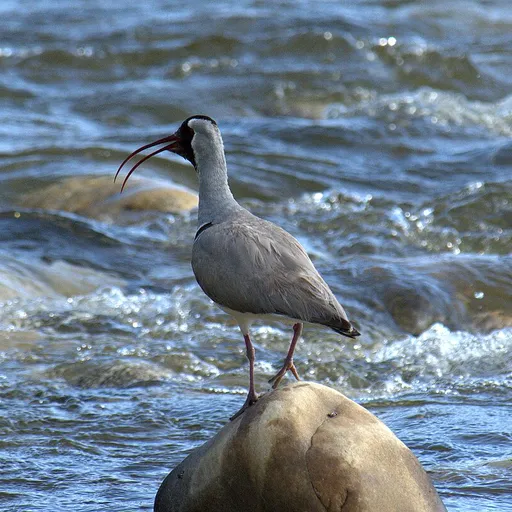
Ibisbill
Ibidorhyncha struthersii
Least Concern
Overview
The Ibisbill (Ibidorhyncha struthersii) is a distinctive wader that is sufficiently unique to merit its own family, Ibidorhynchidae. It is a monotypic species found in the high plateaux of central Asia and the Himalayas, where it inhabits stony riverbeds.
Identification
- Body length is 38–41 cm with a white belly and grey upperparts.
- Features a long, crimson, down-curved bill similar to that of an ibis, along with a black face and black breast band in adults.
- Legs appear greyish-purple in breeding adults but change to crimson shortly after death.
- Call is described as a ringing 'klew-klew' similar to that of a greenshank.
Habitat
This species occurs on shingle riverbanks across the high plateaux of central Asia and the Himalayas, typically at elevations between 1,700 and 4,400 m during the breeding season. It requires slow-flowing water to forage, often found in river valleys with little vegetation and gentle slopes that allow for the accumulation of gravel and pebbles.
Diet
The Ibisbill feeds by probing under rocks and gravel on stream beds to find food. Its diet consists of terrestrial and aquatic invertebrates, including caddisfly and mayfly larvae, grasshoppers, and small fish.
Did you know?
Despite its striking appearance, the Ibisbill is often inconspicuous due to its stony environment. It is also an unexpected swimmer, preferring to cross rivers by swimming rather than flying.
Sources
- Wikipedia · CC BY-SA 4.0
- Wikidata · CC0 1.0