
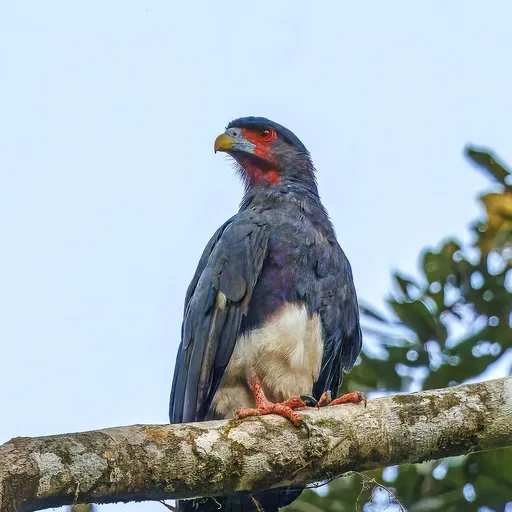
Red-throated Caracara
Ibycter americanus
Least Concern
Listen
XC513592 · Oliver Komar · Darién Province (location based on eBird track, should be accurate within 500 m or less)., Panama · CC BY-SA 4.0
Overview
The red-throated caracara (Ibycter americanus) is a social bird of prey belonging to the family Falconidae. It is unique among caracaras for its specialized diet, which primarily consists of bee and wasp larvae, though it also consumes adult insects and fruit.
Identification
- Size: Males average 51 cm in length, while females average 56 cm, with females being noticeably larger.
- Plumage: Predominantly black plumage, distinguished from the similar black caracara by a white belly, tail feathers, and undertail coverts.
- Head: Both the face and throat are largely bare of feathers, exposing red skin, with only a few black feathers scattered on the throat.
- Sexual Dimorphism: Males and females share a similar appearance, differing mainly in size rather than plumage pattern.
Habitat
Found in the humid lowland and montane forests of Central and South America, ranging from southern Mexico through Peru, Bolivia, and Brazil. This species thrives in subtropical or tropical moist forests, utilizing the sparse vegetation of the understory for visibility while foraging.
Diet
The species specializes in feeding on the larvae of bees and wasps, though it also consumes mature insects and forages on fruits and berries. Hunting typically involves a rapid-fire aerial-diving strategy where birds knock nests onto the forest floor while evading stings, often coordinated in groups with some individuals scouting for predators.
Did you know?
Chemical traces found on the birds' feet are similar to those secreted by Azteca ants, a species that also inhabits the same tree branches and nest sites, suggesting a potential chemical link or cross-contamination. This specialized predation has evolved in response to neotropical wasp behaviour, where defender wasps eventually abandon damaged hives to rebuild elsewhere, a pattern the caracaras exploit.
Sources
- Wikipedia · CC BY-SA 4.0
- Wikidata · CC0 1.0