
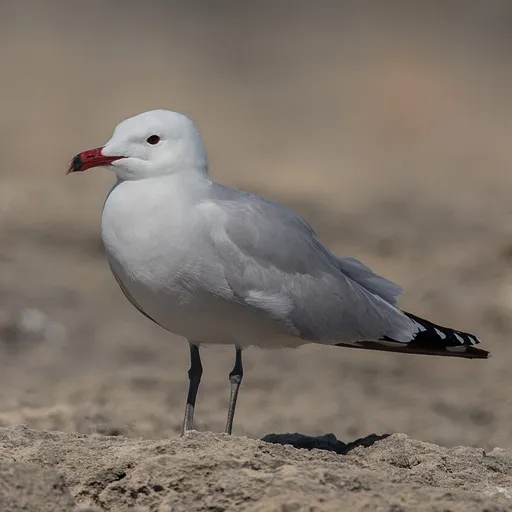
Audouin's Gull
Ichthyaetus audouinii
Overview
Audouin's gull (Ichthyaetus audouinii) is a large gull restricted to the Mediterranean, the western coast of Saharan Africa, and the Iberian Peninsula. It is named after the French naturalist Jean Victoire Audouin and is characterised by its strict coastal and pelagic lifestyle.
Identification
- Resembles a small European herring gull but is distinguished by a short, stubby red bill.
- Features a "string of pearls" pattern of white wing primary tips, lacking the large mirrors seen in some other species.
- Possesses grey-green legs and takes four years to reach adult plumage.
Habitat
This species is strictly coastal and pelagic, breeding colonially or alone on small islands. Its range is restricted to the Mediterranean, the western coast of Saharan Africa, and the Iberian Peninsula, though rare vagrants have been recorded in the Netherlands, England, and Trinidad.
Diet
Unlike many large gulls, Audouin's gull rarely scavenges and is a specialist fish eater. It forages at night, often well out to sea, and may patrol close to beaches while occasionally dangling its legs to increase drag.
Did you know?
In the late 1960s, this was one of the world's rarest gulls with a population of only 1,000 pairs, but it has since recovered to approximately 10,000 pairs through the establishment of new colonies.