
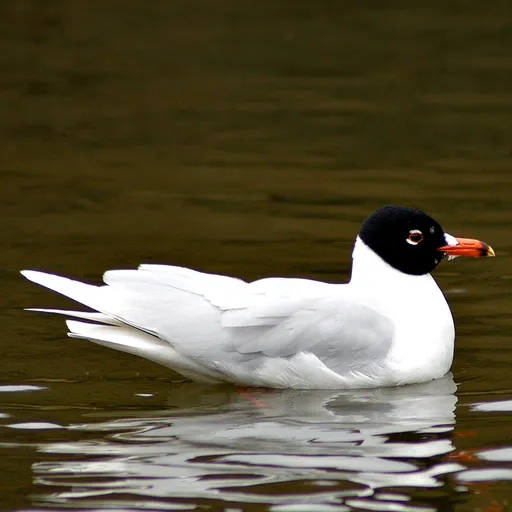
Mediterranean Gull
Ichthyaetus melanocephalus
Listen
XC1134254 · Philippe_Grange · Arrondissement de Béziers (near Vendres), Hérault, Occitanie, France · CC0 1.0
Overview
The Mediterranean gull (Ichthyaetus melanocephalus) is a small gull that breeds almost entirely in the Western Palearctic, particularly around the Black Sea and central Turkey. It has undergone a dramatic range expansion in recent decades, extending its presence across most of Europe as far as Great Britain and Ireland.
Identification
- Slightly larger and bulkier than the black-headed gull, featuring a heavier bill and longer, darker legs.
- Breeding adults display a distinctive white body with a very pale grey mantle and white primary feathers lacking black tips.
- The black hood on breeding adults extends down the nape with distinct white eye crescents, while non-breeding adults show an extensive dusky 'bandit' mask through the eye.
- Possesses a sharp-tipped, parallel-sided dark red bill with a black subterminal band.
- Produces a nasal 'yeah' call, particularly at colonies.
Habitat
This species breeds in colonies within large reed beds, marshes, or on islands in lakes, often nesting alongside black-headed gull colonies where its own population is small. Formerly restricted to the Black Sea and eastern Mediterranean, it now breeds across most of Europe, including Great Britain, Ireland, and various continental countries. In winter, it migrates to Mediterranean and Atlantic coasts.
Diet
As an opportunistic omnivore, the Mediterranean gull feeds on fish, worms, insects, eggs, young birds, offal, and carrion. It is highly gregarious in winter, both when feeding and in evening roosts, but is not a pelagic species and is rarely seen far from coasts.
Did you know?
First-year birds have a black terminal tail band and more black areas in the upper wings, but distinguishably have pale underwings. This bird takes two full years to reach full maturity.