
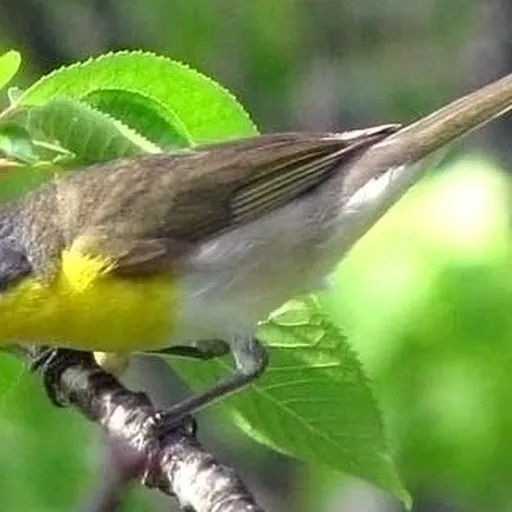
Yellow-breasted Chat
Icteria virens
Least Concern
Listen
XC254465 · Jonathon Jongsma · Oak Draw Rd, Custer State Park, South Dakota, United States · CC BY-SA 4.0
Overview
The yellow-breasted chat (Icteria virens) is a large songbird found in North and Central America that is currently the sole member of its own family, Icteriidae. It was historically classified as a New World warbler but was moved to its distinct family in 2017.
Identification
- Total length ranges from 17 to 19.1 cm with a body mass of 20.2 to 33.8 g.
- Features olive upper parts, white bellies, and bright yellow throats and breasts.
- Distinctive large white eye-rings and blackish legs.
- Song is an odd, variable mixture of cackles, clucks, whistles, and hoots, occasionally mimicking other species such as grey catbirds.
Habitat
This species is found throughout North America, breeding from the southern plains of Canada to central Mexico and mainly migrating to Mexico and Central America for winter. It inhabits areas with dense shrubbery, often consisting of abandoned farmland and rural zones where overgrown vegetation proliferates.
Diet
Yellow-breasted chats are omnivorous and forage within dense vegetation, primarily feeding on insects such as grasshoppers, beetles, and ants, as well as berries like blackberries and wild grapes. Uniquely for a passerine of its size, the chat occasionally grips food with its feet before eating.
Did you know?
Less experienced birdwatchers often overlook the species because its complex song can be mistaken for that of more abundant species like grey catbirds or brown thrashers. Despite its shy nature, chats are vigilant nest guards that successfully resist brood parasitism by brown-headed cowbirds more frequently than other cup-nest builders.
Sources
- Wikipedia · CC BY-SA 4.0
- Wikidata · CC0 1.0