
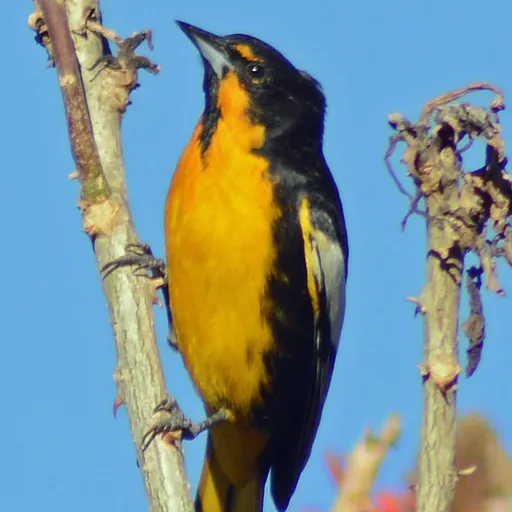
Black-backed Oriole
Icterus abeillei
Least Concern
Overview
The black-backed oriole is a species of bird in the family Icteridae that is endemic to Mexico. Assessed by the IUCN as being of Least Concern, the species is monotypic and was historically treated as conspecific with Bullock's and Baltimore orioles.
Identification
- Adult males display black crown, upperparts, and flanks contrasted with orange cheeks, throat, and underparts, while females are predominantly olivaceous gray.
- Measures 18 to 20.5 cm in length and weighs 31 to 37 g.
- Males feature white wing coverts forming a large patch and yellow tail feathers with black tips, whereas females have duller plumage with a white middle stripe on the throat.
- Vocalisations include a rich warble with scratchy notes and calls described as a loud chatter and a nasal 'chay'.
Habitat
Found in central Mexico, ranging from Durango east to western Tamaulipas and south to Oaxaca, the species breeds in open forests, clearings, gallery forest, and orchards. During the non-breeding season, it inhabits montane oak, pine, and fir forests, typically at elevations between 1,500 and 3,000 m but occasionally as high as 3,900 m.
Diet
The black-backed oriole feeds on insects, spiders, fruit, and nectar. It serves as a significant predator of the toxic monarch butterfly, having evolved a tolerance to the insect's natural poison and preferring to consume its less toxic internal parts.
Did you know?
The bird has evolved a specific tolerance to the natural poison of the monarch butterfly, allowing it to hunt these toxic insects while selectively consuming their less toxic internal parts.
Sources
- Wikipedia · CC BY-SA 4.0
- Wikidata · CC0 1.0