
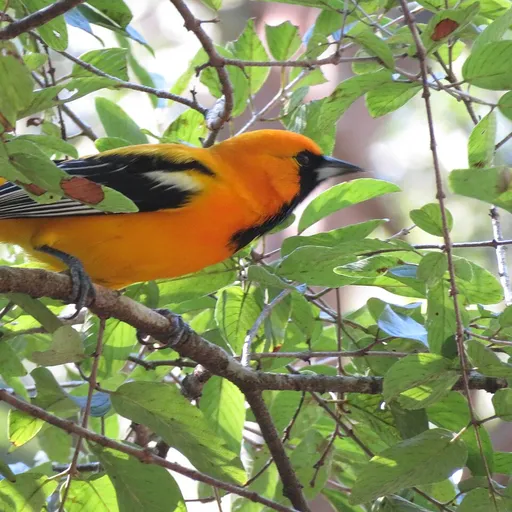
Orange Oriole
Icterus auratus
Least Concern
Overview
The Icterus auratus, commonly known as the orange oriole or Yucatan Oriole, is a small passerine bird native to the Yucatán Peninsula. It belongs to the family Icteridae and is characterised by its vibrant orange plumage and black markings. This species is currently classified as Least Concern on the IUCN Red List.
Identification
- Length of 19–21 cm with a slender body, long wings, and a pointed bill.
- Males feature entirely orange heads and bodies with black wing and tail markings, a black mask between the eyes and bill, and a medium stripe across the upper breast.
- Females appear duller than males, exhibiting an orange-yellow wash and green mantles.
- Vocalisations consist of increasing and decreasing whistles, often described as a fast "chuchu chuchu" or "nyeek".
Habitat
Resident to the lowlands of Mexico, specifically the Yucatán Peninsula, where it does not migrate. The species inhabits forests, woodlands, and abandoned farmland, showing a preference for areas near natural water-holes.
Diet
Feeds on a diverse diet of insects, fruits, and nectar, foraging both individually and in pairs with other orioles. It specifically pries into the hard shells of Talisia olivaeformis to withdraw pulp and also consumes fruit from Metopium brownie.
- The distinctive orange colouration of its feathers is derived directly from the pigments in its diet.
Did you know?
The bright orange colouration of the bird's plumage is directly caused by the coloured pigments found in its food.
Sources
- Wikipedia · CC BY-SA 4.0
- Wikidata · CC0 1.0