
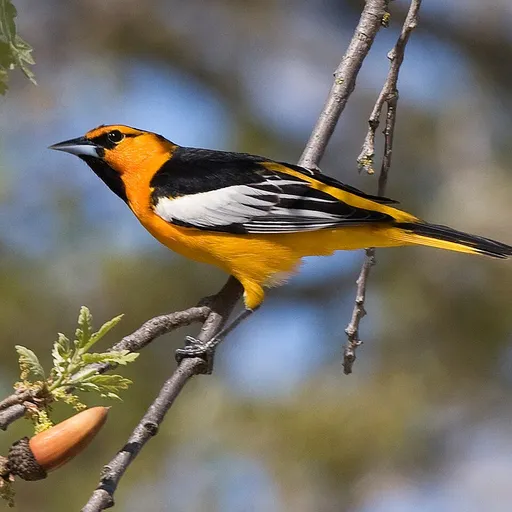
Bullock's Oriole
Icterus bullockii
Overview
Bullock's oriole (Icterus bullockii) is a small New World blackbird native to western North America. It was previously considered a subspecies of the Baltimore oriole, but is now recognised as a distinct species following analysis of breeding data and DNA.
Identification
- Adult males display contrasting yellow-orange and black plumage with a black throat patch, white wing patch, and a black line extending from the eye to the crown.
- Adult females have gray-brown upperparts, duller yellow underparts, and an olive crown, often lacking the distinct black eye-line seen in males.
- The bird measures 6.7–7.5 inches in length with a pointed bill and a straight culmen.
- The song is similar to the Baltimore oriole's but is faster and somewhat more harsh.
Habitat
Native to western North America, the breeding range stretches from British Columbia south to Mexico and east to the Dakotas, Kansas, and northern Central Texas. They prefer habitat edges such as riparian corridors, open deciduous woodland, and scrub forest, often utilising cottonwood, pecan, willow, and in dry areas, salt cedar and mesquite.
Diet
These birds forage in trees and shrubs, making short flights to catch insects, and primarily consume insects, berries, and nectar. They also eat fruits such as oranges and grapes, and are known to use hummingbird feeders or be attracted by grape jelly and water.
Did you know?
Bullock's orioles are named after William Bullock, an English amateur naturalist, and they are known to hybridise with Baltimore orioles in the Midwest where their geographic ranges overlap.