
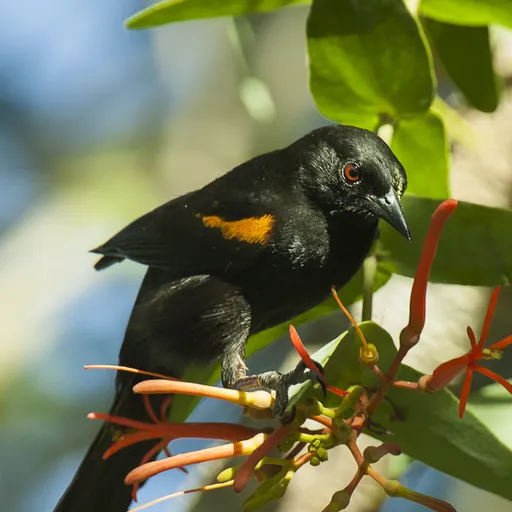
Epaulet Oriole
Icterus cayanensis
Least Concern
Listen
XC242800 · Niels Krabbe · Morona-Santiago: e-slope Cord. de Cutucú: Uuntsuants, Ecuador · CC BY-SA 4.0
Overview
The epaulet oriole (Icterus cayanensis) is a species of bird in the family Icteridae found across the Amazon Basin. It is currently classified as Least Concern on the IUCN Red List, with populations that appear stable and widely distributed.
Identification
- Approximately 22 cm in length with a blackish bill and leaden gray to blackish legs.
- The nominate subspecies is almost entirely black, featuring yellow lesser and median wing coverts visible as epaulets on the closed wing.
- Subspecies I. c. chrysocephalus is mostly black but distinguished by a golden-yellow crown, nape, rump, epaulets, and thighs.
- The song of the nominate subspecies is described as a varied series of ascending and descending notes mixed with clicks and buzzes, while I. c. chrysocephalus sings a slow series of notes usually grouped in phrases of two to three.
Habitat
Inhabiting the Amazon Basin, this species occupies forest edges, clearings, canopies, swamp forests, and gallery forests, occasionally visiting parks and gardens. It favours moriche palm groves in marshes and along waterways across much of its range. Elevational limits vary significantly, ranging from sea level to 1,500 m in Peru.
Diet
Although not extensively studied, the diet is believed to consist mostly of insects and other arthropods, supplemented by fruits, nectar, and sap. The bird usually forages singly or in pairs within the forest canopy, though it will forage down to the ground in more open areas and may join mixed-species feeding flocks.
Did you know?
The nest is constructed as a hammock woven from plant fibres and attached to the underside of a large leaf or palm frond. This structure is known to be parasitised by the shiny cowbird, which lays its own eggs in the epaulet oriole's nest.
Sources
- Wikipedia · CC BY-SA 4.0
- Wikidata · CC0 1.0