
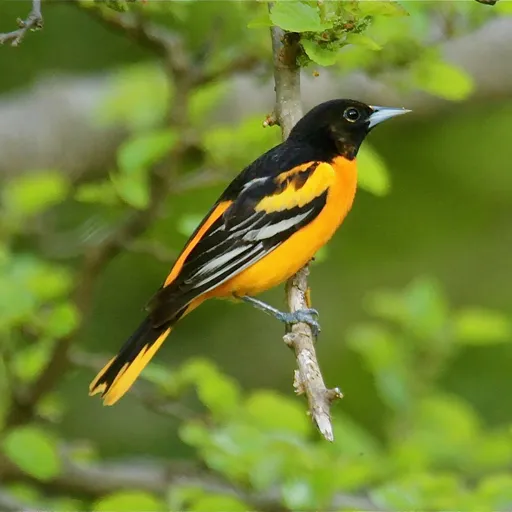
Baltimore Oriole
Icterus galbula
Least Concern
Listen
XC178046 · Jonathon Jongsma · Wild River State Park, Chisago County, Minnesota, United States · CC BY-SA 4.0
Overview
The Baltimore oriole (Icterus galbula) is a medium-sized passerine and small icterid blackbird common in eastern North America as a migratory breeding bird. It is currently classified as a species of Least Concern on the IUCN Red List.
Identification
- Plumage: Adult males have orange underparts, shoulder patches, and rumps with the rest of the plumage being black; adult females are yellow brown on the upper parts and dull orange yellow on the breast and belly.
- Size and Build: Medium-sized birds measuring 17–22 cm in length, characterised by a sturdy body, longish tail, fairly long legs, and a thick, pointed bill.
- Markings: Adults always have white bars on the wings.
- Song: A short set of recognisable, sweet whistles that sound like "tyew, pyeer, peededoo," and "teer," with calls including an unusual nasal "veeer" and high calls like "tyew-li and kleek."
Habitat
The species breeds in the Nearctic, ranging from the Canadian Prairies and eastern Montana through eastern North America to central Mississippi, Alabama, and northern Georgia, and winters in the Neotropics. They are often found high in large, leafy deciduous trees, forest edges, and partially wooded wetlands, but are adaptable enough to breed in orchards, farmland, urban parks, and suburban landscapes with woodlots. In Mexico, they winter in flowering canopy trees, often over shade coffee plantations.
Diet
Baltimore orioles forage in trees and shrubs, acrobatically clambering, hovering, and hanging among foliage to comb high branches. They primarily eat insects, berries, and nectar, with a special preference for ripe, dark-coloured fruits such as mulberries, cherries, and grapes, often using their bills to "gape" open the fruit. They are notable for consuming forest tent caterpillars, beating the larvae against branches to remove protective hairs before eating them.
Did you know?
Unlike many other fruit-eating birds, Baltimore orioles seem to prefer only ripe, dark-coloured fruit, seeking out the darkest mulberries, reddest cherries, and deepest-purple grapes while ignoring green grapes and yellow cherries even if they are ripe. They also use their bills to stab into soft fruits and open them to lap up the juice with their tongues.
Sources
- Wikipedia · CC BY-SA 4.0
- Wikidata · CC0 1.0