
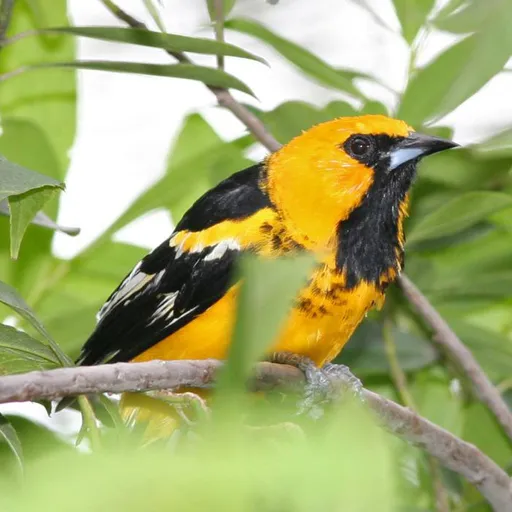
White-edged Oriole
Icterus graceannae
Least Concern
Listen
XC242801 · Niels Krabbe · El Oro: Carcabon, Arenillas Ecological Reserve, Ecuador · CC BY-SA 4.0
Overview
The white-edged oriole, Icterus graceannae, is a species of bird in the family Icteridae that belongs to the group of New World orioles and blackbirds. It is a year-round resident found in a narrow coastal region of South America and is currently assessed as a species of Least Concern by the IUCN.
Identification
- Males and females share similar plumage, with adults appearing mostly orange-yellow, featuring a black back, black lores, and a distinct black 'mask' and 'bib'.
- The eponymous wide white edges appear at the bases of the innermost secondaries and tertials, visible as a large white patch on the closed wing.
- Juveniles are duller and greener than adults, with olive tips on the back and significantly less white on the flight feathers.
- The bird possesses a dark brown iris, a black bill with a grey base, and greyish blue legs, and can be recognised by its throaty 'jori-jori' call.
Habitat
This species inhabits a narrow band along the Pacific coast from central Manabí Province in west-central Ecuador south into northwestern Peru's La Libertad Department. It primarily occupies dry deciduous forest and arid scrublands, with a presence in the adjoining subtropical zone in far southern Ecuador, and is found mostly below 400 m in Ecuador but locally as high as 1,800 m in Peru.
Diet
Although its specific diet has not been formally studied, it is assumed to consist of arthropods, fruit, and nectar. The bird usually forages in pairs or family groups.
Did you know?
The species was named by John Cassin in 1867 'in honor of my highly esteemed friend, Miss Grace Anna Lewis...accomplished as a teacher of Natural History'. Its nesting habit involves constructing a bag-like structure from plant fibers that hangs by its rim, typically from a branch fork.
Sources
- Wikipedia · CC BY-SA 4.0
- Wikidata · CC0 1.0