
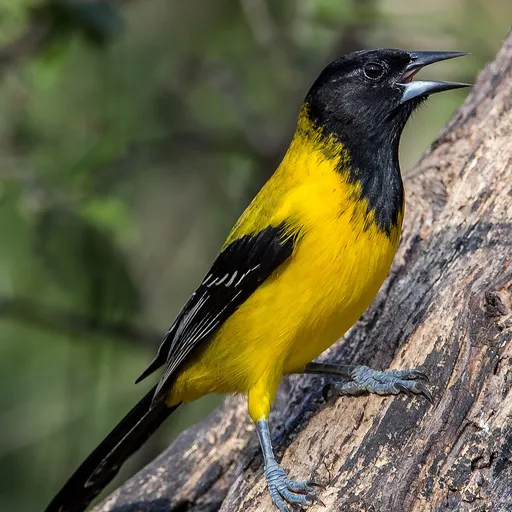
Audubon's Oriole
Icterus graduacauda
Least Concern
Listen
XC406544 · Leonardo Guzman Hernandez · Santiago, Nuevo León, Mexico · CC BY-SA 4.0
Overview
Audubon's oriole (Icterus graduacauda), formerly known as the black-headed oriole, is a New World passerine found in the forests and thickets of southeastern Texas and the Mexican coast. It is the only species to possess both a black hood and a yellow body.
Identification
- Males have a black hood, mandible, throat, and tail, with wings that are black but fringed with white on the flight feathers.
- The back and vent are yellow washed with olive, while the underside is almost uniformly yellow.
- Yellow epaulets are formed by the secondary coverts.
- The song consists of a series of slow, slurry whistles, and calls include a nasal 'ike, ike, ike' and a whistled 'peu'.
Habitat
This species inhabits dense evergreen forests and thickets, preferring riparian areas where it can forage in the shade. Its range extends from the lower Rio Grande valley to northern Querétaro in the east, and from Nayarit to southern Oaxaca in the west.
Diet
It feeds on insects, spiders, and fruits, inserting its bill into soft dead wood or plants to force them open and expose hidden insects. It also accepts sunflower seeds from bird feeders.
Did you know?
A mating pair usually incubates two broods per year, but chicks hatched from the later brood are usually unable to survive the winter.
Sources
- Wikipedia · CC BY-SA 4.0
- Wikidata · CC0 1.0