
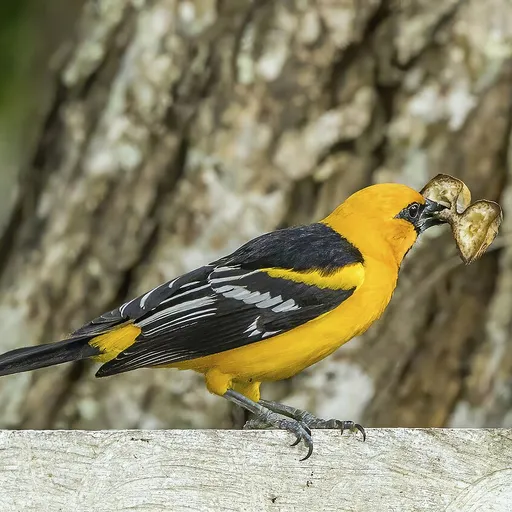
Altamira Oriole
Icterus gularis
Least Concern
Overview
The Altamira oriole (Icterus gularis) is a New World oriole that is the largest in the genus Icterus. It is a permanent resident found across subtropical lowlands in Mexico and Central America, having spread to southern Texas since 1939.
Identification
- Measures 25 cm in length and weighs 56 g, making it the largest oriole in its genus.
- Males and females are sexually monomorphic, featuring a black bill, throat, back, and long tail.
- Wings are black with white-fringed flight feathers, creating a single white wing bar and spots when folded, while secondary coverts form orange epaulets.
- The underside is almost uniformly orange or yellowish-orange.
- Song consists of clear, slow musical whistles, contrasting with calls that include harsh whistles, rasping chatter, and nasal 'ike's.
Habitat
The species inhabits semi-arid areas with scattered trees and open riparian woodland in the Mexican Gulf and Pacific coasts, northern Central America, and southern Texas. It nests in open woodland and is a permanent resident rather than a migratory bird.
Diet
As a forage gleaner, it searches for food from the tree-tops down to the near-ground bottom of the tree, sometimes in the undergrowth. Its diet consists mainly of insects such as grasshoppers, crickets, and caterpillars, along with fruit including small fruits, hackberries, and figs.
Did you know?
Unlike migratory orioles that breed in the US, the Altamira oriole is sexually monomorphic, meaning both males and females possess elaborate coloration and patterning. It is a solitary nester with an average distance of a quarter kilometer between nests, showing little aggression or territoriality during the breeding season.
Sources
- Wikipedia · CC BY-SA 4.0
- Wikidata · CC0 1.0