
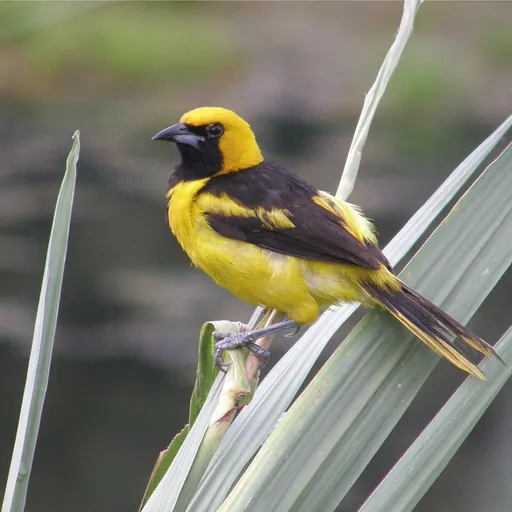
Yellow-tailed Oriole
Icterus mesomelas
Least Concern
Listen
XC242804 · Niels Krabbe · Manabí: Río Ayampe, Ecuador · CC BY-SA 4.0
Overview
The yellow-tailed oriole (Icterus mesomelas) is a large passerine bird in the New World family Icteridae. It is classified as Least Concern on the IUCN Red List, although its numbers are declining in parts of its range due to the cage-bird trade.
Identification
- Measures 22–23 cm long and weighs 70 g.
- Predominantly yellow plumage with a black back, lower face and upper breast.
- Black wings feature yellow epaulets, and the tail is black with yellow margins when viewed from above, appearing almost entirely yellow from below.
- Song consists of a melodic repetition of rich whistles and chucky notes, often performed as a duet by the male and female.
- Juvenile birds distinguish themselves by replacing the black on the back and tail with olive-green feathers.
Habitat
Breeding across southern Mexico to western Peru and northwestern Venezuela, this species inhabits dense thickets with vines, Heliconias and similar dense growths in swampy lowlands. In Peru, it is also found in a river valley corridor.
Diet
The yellow-tailed oriole forages in pairs or small groups within dense vegetation, primarily feeding on insects. It also consumes nectar and specific fruits, such as gumbo-limbo (Bursera simaruba).
Did you know?
This species is the only oriole with prominent yellow in its tail, a feature that gives the bird its common name. It is highly valued by humans for both its appearance and its beautiful song, making it a target for the cage-bird trade.
Sources
- Wikipedia · CC BY-SA 4.0
- Wikidata · CC0 1.0