
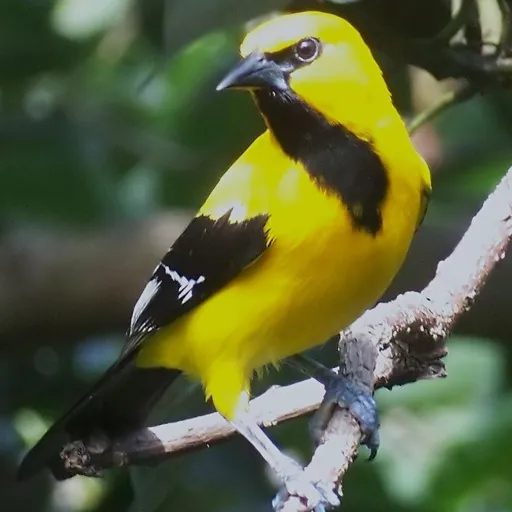
Yellow Oriole
Icterus nigrogularis
Least Concern
Listen
XC719899 · Hugo Oliveros-Salas · Usiacurí, Usiacurí, Atlántico, Colombia · CC0 1.0
Overview
The yellow oriole (Icterus nigrogularis) is a passerine bird in the family Icteridae found in northern South America and the Caribbean. It is classified as Least Concern by the IUCN, with a stable population across its wide distribution.
Identification
- Adult males are primarily bright yellow with black lores, a black facial mask, and a black bib extending from the chin to the upper breast.
- Wings are mostly black with white edges on the flight feathers and white tips on the greater coverts, while the tail is black with small white tips on the outer feathers.
- Males measure 20 to 21 cm in length and weigh approximately 38 g; females are similar but feature a greenish wash on the back.
- The song consists of a detached series of short musical phrases such as 'tur-a-leet' and 'tur-sweet', often accompanied by a sharp 'ka-chek' call.
Habitat
This species inhabits semi-open to open environments, including arid scrublands, thorn scrub, dry deciduous forest, and human-modified areas like urban parks and fruit plantations, while avoiding humid closed forest. Its range covers northern South America from Colombia through Venezuela and the Guianas to Brazil, as well as islands such as Trinidad, Aruba, Bonaire, and Curaçao.
Diet
The yellow oriole feeds primarily on insects, fruits, and nectar, capturing prey by gleaning, pecking, and probing bark, twigs, and leaves. It forages from near the ground up to the forest canopy, usually singly, in pairs, or in small family groups, and is known to take nectar from both wild flowers and hummingbird feeders.
Did you know?
Both sexes construct long pouch-like nests by weaving plant fibers, but they frequently incorporate human-made materials such as plastic, cloth, and string into the structure.
Sources
- Wikipedia · CC BY-SA 4.0
- Wikidata · CC0 1.0