
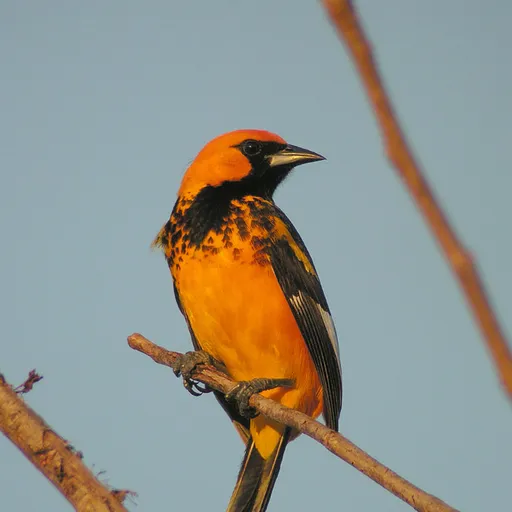
Spot-breasted Oriole
Icterus pectoralis
Least Concern
Overview
The spot-breasted oriole is a species of bird in the family Icteridae found from Mexico to Costa Rica, with an introduced population in southern Florida. It is classified as Least Concern by the IUCN, although its population is believed to be decreasing.
Identification
- Adults feature a deep orange head and nape with a black mask, throat, and 'bib' on the upper breast, while the underparts below are pale orange with distinctive black spots on the breast. Wings are mostly black with orange-yellow coverts and white edges on the flight feathers, creating a large white patch on the closed wing. The species measures approximately 21 cm in length, with males averaging 53 g and females 45 g. Song consists of a sweet, melodic series of repeated clear whistles described as 'eeeep!-weu'peeer', accompanied by calls like a harsh, scratchy 'raannk' and hoarse chatter.
Habitat
Primarily inhabiting the Pacific slope of Mexico and much of Central America, the species favours arid woodlands and scrublands containing Acacia and mesquite trees, as well as lightly treed pastures, ranches, and village edges. In its introduced range in southeastern Florida, it relies on introduced shrubs and trees that provide flowers and fruit year-round. Elevations range from 500 m in Costa Rica to 1,600 m in northern Central America.
Diet
Feeds primarily on insects, other invertebrates, fruits, and nectar, capturing prey by gleaning and probing foliage. Foraging typically occurs in pairs or small family groups, expanding to small flocks during the non-breeding season, often in the company of other orioles.
Did you know?
The female constructs a pouch nest woven from grass, vines, plant fibers, and fungal rhizomorphs, typically hanging it from a branch of a thorny tree between 6 and 18 m above the ground, though utility wires have also been used. Brood parasitism by the bronzed and giant cowbirds is a frequent occurrence.
Sources
- Wikipedia · CC BY-SA 4.0
- Wikidata · CC0 1.0