
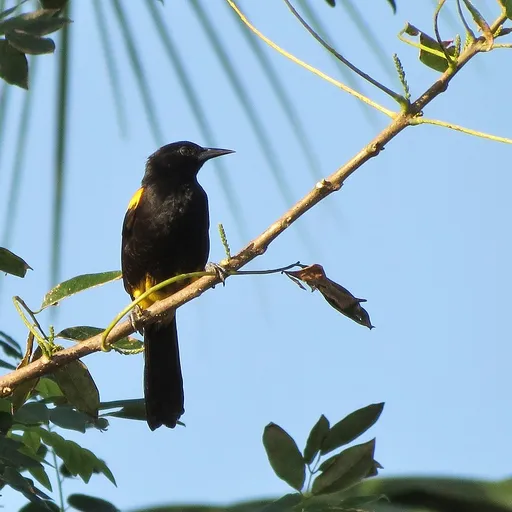
Puerto Rican Oriole
Icterus portoricensis
Least Concern
Overview
The Puerto Rican oriole, also known as the calandria, is a bird in the family Icteridae that is endemic to Puerto Rico. Previously considered part of a larger species group, it was recognised as a distinct full species by the American Ornithologists' Union in 2010.
Identification
- Adults are predominantly black with yellow on the lower belly and shoulders, whereas juveniles are tawny with an olive-tinted rump.
- Males and females are similar in size, weighing approximately 41.0 g and 36.6 g respectively, with average wingspans of 96.9 mm and 92.1 mm.
- The song consists of clicks or high-pitched whistles with a frequency range of 3.6 to 5.3 kHz, combining 15 to 27 different notes.
- Juveniles develop their bright adult colours as they age, with the tawny adolescent plumage providing camouflage in dense forest environments.
Habitat
This species is endemic to Puerto Rico and inhabits tropical forests, mangrove forests, and plantations. It displays a natural preference for nesting in palm trees.
Diet
The oriole primarily forages in dense vegetation for a diverse diet that includes fruits, insects, lizards, nuts, and grains.
Did you know?
Unlike many temperate-zone birds where only males sing, both male and female Puerto Rican orioles sing a similar repertoire, a trait theorised to correlate with increased female-female competition and territory defence in tropical lifestyles.
Sources
- Wikipedia · CC BY-SA 4.0
- Wikidata · CC0 1.0