
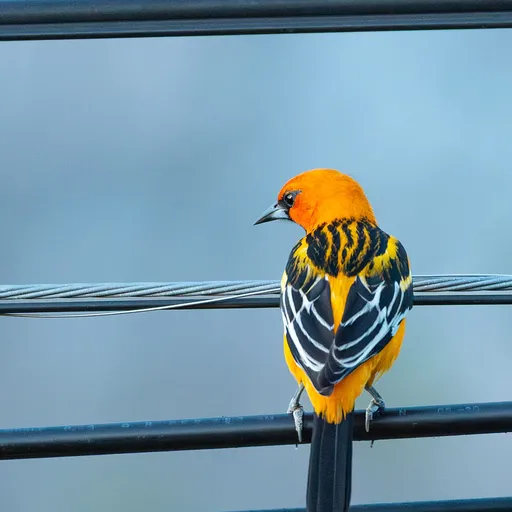
Streak-backed Oriole
Icterus pustulatus
Least Concern
Overview
The streak-backed oriole (Icterus pustulatus) is a medium-sized passerine bird in the family Icteridae. It is a year-round resident found primarily in Mexico and Central America, with occasional records in the United States.
Identification
- Length of 19 to 21 cm, with adult males weighing approximately 43 g and females 35 g.
- Adult males of the nominate subspecies display a deep orange head and breast with black lores, chin, and upper breast, while their upperparts are orange with heavy black streaks on the mantle and back.
- Wings are mostly black with white tips on median coverts forming large bars, and the tail is predominantly black with white tips and outer edges.
- Song consists of a pleasant series of sweet, clear whistles, with calls including a 'saweet!-taweee!-tawee-tawee' and soft churr's.
Habitat
Inhabits low-elevation scrublands, primary and secondary deciduous forests, gallery forests, savannas, mangroves, and roadside areas with trees. The species ranges from sea level to 1,900 m in general, though specific elevational limits vary by location, such as 500 m in Costa Rica. It is found across Mexico, from Guatemala to Costa Rica, and occasionally in southern and western parts of the United States.
Diet
Feeds primarily on insects and other invertebrates, fruits, and nectar. Captures prey by gleaning and probing bark, twigs, and leaves, usually foraging in pairs or small family groups.
Did you know?
Its nest is a long bag or pouch woven from plant fibers and fungal rhizomorphs that usually hangs high in a thorny tree or sometimes from a utility wire.
Sources
- Wikipedia · CC BY-SA 4.0
- Wikidata · CC0 1.0