
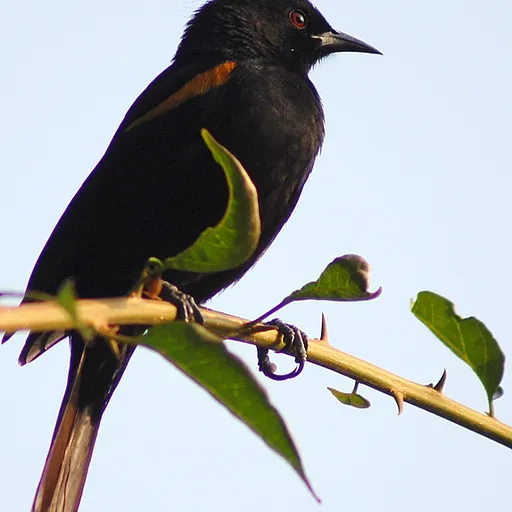
Variable Oriole
Icterus pyrrhopterus
Least Concern
Overview
The variable oriole is a species of bird in the family Icteridae, currently classified as Least Concern by the IUCN. It is found across several South American countries, including Argentina, Bolivia, Brazil, Paraguay, and Uruguay, with occasional vagrancy to Chile.
Identification
- Approximately 20 cm long, with males averaging 33 g and females 30 g.
- Adults are almost entirely black, though plumage varies by subspecies with chestnut, tawny, or yellow epaulets on the wings and some yellow thigh feathers in certain forms.
- Possesses a reddish tawny to dark red-brown iris, a slender, straight, blackish bill, and leaden gray to blackish legs and feet.
- Song is described as fast, variable, and pleasant but not overly musical, often accompanied by a sharp 'keet' call and mimicry of other bird vocalisations.
Habitat
This species inhabits a wide variety of landscapes, predominantly somewhat open areas such as forest clearings, edges, gallery forest, palm savanna, and humid Chaco woodlands. It is also found in parks and gardens, ranging from sea level up to 2,500 m in Bolivia, though it is rare at higher elevations.
Diet
Feeds on insects, other arthropods, fruit, nectar, and flowers, almost always foraging in trees and frequently hanging upside-down to reach food. During the non-breeding season, it may feed in flocks of up to 30 individuals and often joins mixed-species feeding flocks, while in the breeding season it forages mainly in pairs and family groups.
Did you know?
The variable oriole is a significant victim of brood parasitism by the shiny cowbird, which lays its eggs in the oriole's nests. The bird's nest is a shallow basket woven from thin plant fibers, often fastened to the underside of a palm frond, large leaf, or even in abandoned nests of other birds.
Sources
- Wikipedia · CC BY-SA 4.0
- Wikidata · CC0 1.0