
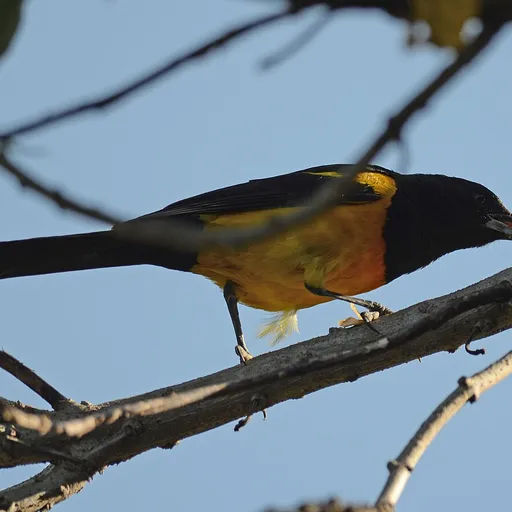
Black-vented Oriole
Icterus wagleri
Least Concern
Overview
The black-vented oriole (Icterus wagleri) is a species of bird in the family Icteridae, found across parts of Central America and Mexico. Assessed as Least Concern by the IUCN, it maintains a very large range, although its estimated population of at least 500,000 mature individuals is believed to be decreasing.
Identification
- Males have a black head, throat, upper breast, mantle, back, rump, and tail, while underparts are orange-yellow, sometimes tinged with chestnut below the breast.
- Females are duller than males, generally appearing more yellow than orange-yellow down to the undertail coverts.
- A black wing shows orange-yellow lesser and median coverts that appear as an epaulet on the closed wing.
- Both sexes possess a brown iris, a black bill with a bluish-grey base to the mandible, and bluish-grey legs and feet.
- The song is described as rather unmusical, consisting of a mix of fast warbles with twittering and nasal or rasping notes.
Habitat
The species inhabits dry scrublands, pine-oak forests, semi-deciduous and deciduous forests, and gallery forests in the upper tropical and lower temperate zones. Its range covers El Salvador, Guatemala, Honduras, Mexico, and Nicaragua, with a disjunct distribution that includes a gap at the Isthmus of Tehuantepec.
Diet
Feeding on insects, other arthropods, fruit, and nectar, the black-vented oriole forages in pairs and family groups within the mid-to-upper levels of the forest.
Did you know?
The black-vented oriole constructs its nest as a shallow "hammock" woven from plant fibres, typically hung from a tree branch but occasionally attached to the underside of a palm or banana leaf.
Sources
- Wikipedia · CC BY-SA 4.0
- Wikidata · CC0 1.0