
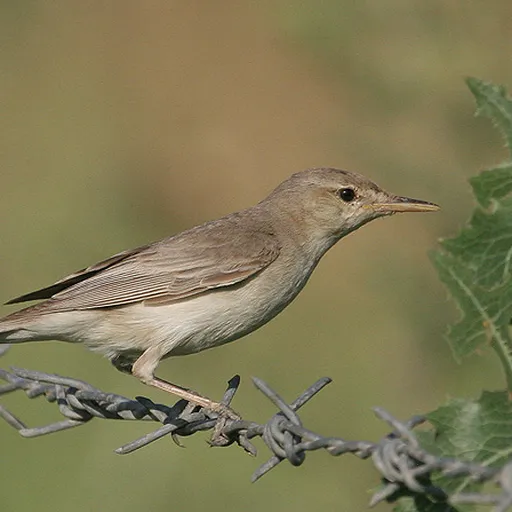
Eastern Olivaceous Warbler
Iduna pallida
Least Concern
Listen
XC900357 · Peter Brenner · Rodopi (near Profitis Ilias), East Macedonia and Thrace, Decentralized Administration of Macedonia and Thrace, Greece · CC BY-SA 4.0
Overview
The eastern olivaceous warbler (Iduna pallida) is a small passerine bird characterised by drab plumage tones and classified as Least Concern on the IUCN Red List. It belongs to the acrocephaline warbler family, Acrocephalidae, within the genus Iduna.
Identification
- Medium-sized warbler appearing more like a very pale reed warbler than the melodious warbler.
- Plain pale brown back with whitish underparts; young birds exhibit more buff colouring on the belly.
- Strong, pointed bill with grey legs.
- Exhibits a characteristic downward tail flick and produces a fast, nasal babbling song.
Habitat
This species inhabits dry open country, including cultivated land, provided there are bushes or some trees present. Its range spans breeding grounds in southeastern Europe, the Middle East, and adjacent western Asia, with wintering grounds in the northern Afrotropics, specifically sub-Saharan Africa or Arabia.
Diet
Like most warblers, the eastern olivaceous warbler is insectivorous.
Did you know?
The species name pallida is Latin for 'pale', reflecting its appearance, while its western counterpart is often referred to as the isabelline warbler to distinguish the two.
Sources
- Wikipedia · CC BY-SA 4.0
- Wikidata · CC0 1.0