
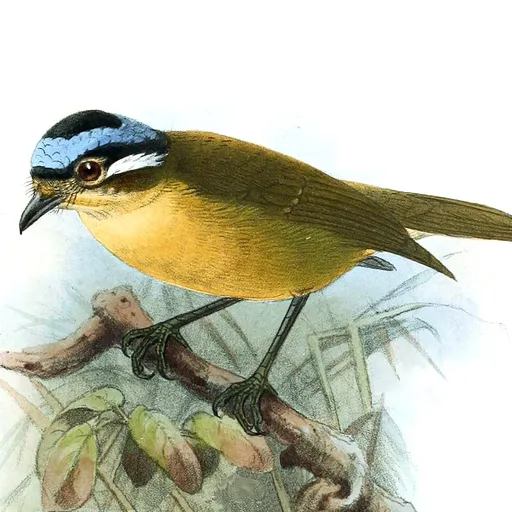
Blue-capped Ifrit
Ifrita kowaldi
Least Concern
Overview
The blue-capped ifrit (Ifrita kowaldi) is a small passerine bird and the sole member of the family Ifritidae, native to the montane rainforests of New Guinea. Recognised as an ancient relict species dating back to the Oligocene epoch, it is notable for being one of the few toxic birds in the world.
Identification
- Plumage: Brown upperparts with finely dotted wing edges and light-yellow underparts; head features a bright blue cap outlined in black, a small black crown spot, and a long white stripe beside the eye with a thin black strip within it.
- Size: Measures 16–17 cm in length and weighs 34–36 g, with a stout body, broad chest, and short, rounded wings.
- Legs: Booted legs with feathers extending down to stout, clawed feet.
- Vocalisation: Produces an upbeat "toowa-tee!" song accompanied by a short, dry "wik" call.
Habitat
Endemic to Western New Guinea and Papua New Guinea, the species inhabits subtropical and tropical moist montane forests where it is highly dependent on the forest ecosystem. Found at elevations ranging from 100 to 4,000 meters, it is most commonly observed at altitudes of 1,500 meters or above across provinces such as the Southern Highlands, Western Highlands, Enga, Morobe, and Eastern Highlands.
Diet
This insectivorous bird feeds primarily on insects and worms, foraging carefully through moss, branches, and tree trunks. It occasionally supplements its diet with soft fruits and acquires its defensive batrachotoxin from consuming Chroesine beetles.
Did you know?
Blue-capped ifrits accumulate batrachotoxin, a neurotoxin believed to be deadlier than cyanide, in their feathers and skin, a trait enabled by a specific mutation in the SCN4A gene that renders them immune to their own poison.
Sources
- Wikipedia · CC BY-SA 4.0
- Wikidata · CC0 1.0