
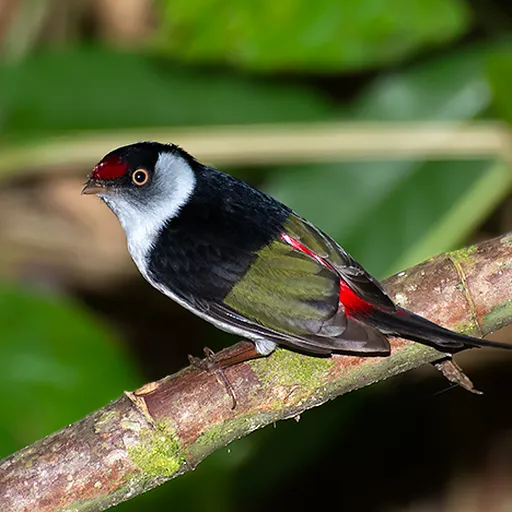
Pin-tailed Manakin
Ilicura militaris
Least Concern
Overview
The pin-tailed manakin (Ilicura militaris) is a suboscine species of bird belonging to the manakin family, Pipridae. It is endemic to the eastern coast of Brazil and is characterised by pronounced sexual dimorphism and an elaborate courtship ritual. The species is currently listed as Least Concern by the IUCN, although its population is suspected to be in decline.
Identification
- Males possess a bright white neck, chest, auriculars, and flanks, contrasted by black and dark-green wings and a distinctively red fore-crown and rump.
- Both sexes feature a signature pin-shaped tail with a small fork near the tip, a slightly elongated head with a raised forehead, and bright yellow-orange irises.
- Females are primarily muted or olive-green, distinguished by light grey necks and auriculars along with a cream-coloured chest.
- Vocalisations are quiet and high-pitched, resembling a descending series of three to eight 'see-see-see' sounds.
Habitat
The pin-tailed manakin inhabits the humid Atlantic Forest of eastern Brazil, ranging from the state of Bahia to Rio Grande Do Sul. It resides in subtropical and tropical moist lowland and montane forests, typically spending its time in the lower and middle strata of the rainforest. The species is non-migratory and is generally uncommon to fairly uncommon within its range.
Diet
As a primary frugivore, the pin-tailed manakin feeds mostly on small berries, occasionally consuming small insects. It forages primarily at forest edges on small fruit trees and shrubs, plucking food from the air using diving and snatching motions rather than spending time on the plant. Documented food sources include the yellow magnolia and ripe chickweed plant fruits.
Did you know?
The vibrant red fore-crown and rump of the male are produced by rhodoxanthin, a rare pigment that is hypothesised to be transformed from keto-carotenoids found in the bird's diet. This pigment is unique for its ability to reflect and absorb light from longer wavelengths, producing a wide range of reds and yellows.
Sources
- Wikipedia · CC BY-SA 4.0
- Wikidata · CC0 1.0