
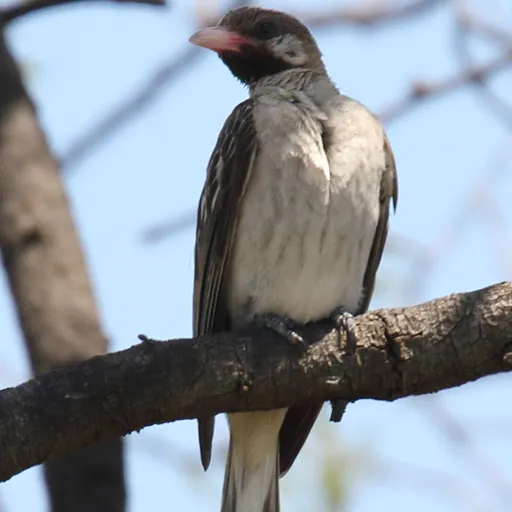
Greater Honeyguide
Indicator indicator
Least Concern
Overview
The greater honeyguide (Indicator indicator) is a paleotropical near passerine bird related to woodpeckers and classified on the IUCN Red List as Least Concern. It is best known for its remarkable behaviour of guiding humans to wild bee colonies in exchange for leftover beeswax.
Identification
- Approximately 20 cm in length with a dark grey-brown body and white underparts.
- Males have a black throat and pink bill, with a distinctive yellow shoulder patch and whitish streaked wings.
- Females are duller with a blackish bill and black throat, while immature birds feature olive-brown upperparts, a white rump, and a yellow throat.
- Characterised by bold white patches on the sides of the tail.
Habitat
A resident breeder found throughout sub-Saharan Africa, with the notable exception of the West African rain forest. It inhabits a variety of wooded environments, showing a particular preference for dry open woodland.
Diet
The species feeds primarily on the contents of bee colonies, including beeswax, eggs, larvae, pupae, and waxworms, often entering nests while bees are torpid in the early morning or scavenging at hives robbed by humans or honey badgers. It occasionally consumes fruit and rarely bird eggs, while young birds depend on fruit brought by their host parents.
Did you know?
The greater honeyguide's guiding behaviour relies on specific human cultural signals; for example, the Boran people of East Africa use a loud whistle called the fuulido to attract the birds, which effectively doubles their encounter rate. However, this mutualism may be disappearing in areas like parts of Kenya where people no longer respond to the birds, leading the honeyguides to stop guiding.
Sources
- Wikipedia · CC BY-SA 4.0
- Wikidata · CC0 1.0