
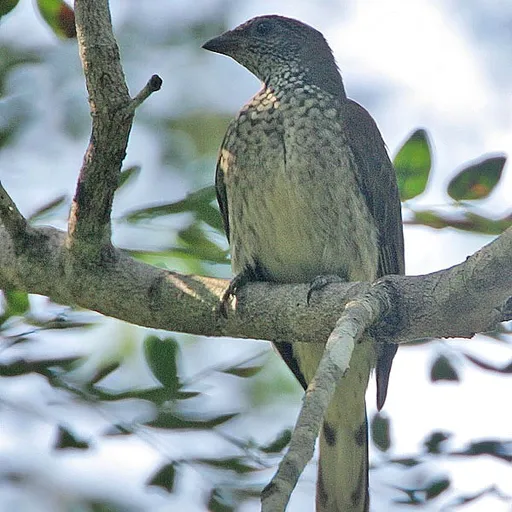
Scaly-throated Honeyguide
Indicator variegatus
Least Concern
Overview
The scaly-throated honeyguide (Indicator variegatus) is a small bird in the family Indicatoridae that maintains a mutualistic relationship with humans by leading beekeepers to bee nests. It is classified as Least Concern on the IUCN Red List and is found across various countries in eastern and southern Africa. The species is generally considered fairly common and widespread, though it can be somewhat uncommon in parts of its range such as Somalia, Kenya, and Tanzania.
Identification
- Mature individuals measure 18–19 cm in length and appear olive with a white or buffy yellow tinge on the middle and lower breast. Throat and breast markings vary between scaly to streaky olive-gray and white, distinguishing it from most other honeyguides except the spotted honeyguide, which has browner upperparts and less spotting. Stripes are present on the face and crown, sometimes reaching the nape, while the rump is yellow-green and the tail displays a black-tipped white outer pattern with short outermost feathers. Legs and feet are typically greenish-gray or yellowish-olive, with eye colours ranging from hazel to deep brown. The main song is a churring trill, described as a low croak turning into a loud rising call lasting three to four seconds, often sung while perched under a tree canopy. Males may also produce an aggressive song-like call sounding like 'dddddddddeeeet-tyew', and both sexes can make a 'kizz-kizz-kizz' sound when chasing other birds.
Habitat
This species inhabits dense woodland, thickets, forest, overgrown plantations, and bamboo thickets, typically below 2,200 metres in elevation, though it has been observed up to 3,350 metres on Mt. Elgon. It is found in Angola, Burundi, DRC, Eswatini, Ethiopia, Kenya, Malawi, Mozambique, Rwanda, Somalia, South Africa, South Sudan, Tanzania, Uganda, Zambia, and Zimbabwe.
Diet
The diet primarily consists of beeswax, honey, insects including bees, grubs, aphids, ants, flies, termites, beetles, and caterpillars, along with arthropods and occasionally seeds and fruits such as figs. It forages by tearing at honeycomb or wax with its bill, holding the wax between its legs to consume it, and may join mixed-species foraging flocks or flycatch from perches. The species has a specialised digestive system with prolonged gut transit time and high levels of lipase to process the large amounts of wax it consumes.
Did you know?
Scaly-throated honeyguides are brood parasites that lay eggs in the nests of barbet, tinkerbird, and woodpecker species, and their nestlings are born with fully-developed transparent bill hooks that may be used to destroy host eggs or kill host young. Fledgling honeyguides can be fed up to 45 times in eight hours by their host parents, and they fledge after 27 to 35 days.
Sources
- Wikipedia · CC BY-SA 4.0
- Wikidata · CC0 1.0