
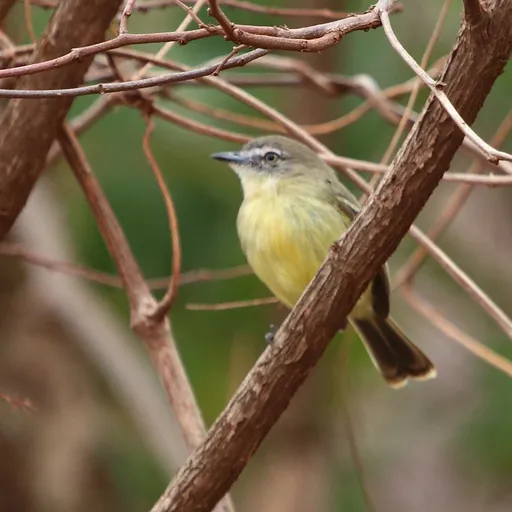
Pale-tipped Inezia
Inezia caudata
Least Concern
Overview
The pale-tipped inezia, also known as the pale-tipped tyrannulet, is a small species of tyrant flycatcher found in northern South America. It is classified as a bird of Least Concern by the IUCN due to its large range and stable population.
Identification
- About 12 cm long and weighing 7.5 to 10 g, with a thin black bill and grey to slate legs.
- Features a grayer forecrown, a white supercilium and broken eye-ring that appear like spectacles, and a dusky line through the eye.
- Underparts are pale to bright yellow with a whitish chin, often showing a dusky wash on the breast sides that resembles a vest.
- Song is a loud, descending TEEP! tedede or Teep, tee'r'r, often sung in duet by pairs.
Habitat
Inhabits a variety of landscapes including deciduous and semi-deciduous woodlands, gallery forest, shrubby areas with trees, and occasionally várzea forest and mangroves. The range extends from the Llanos of northeastern Colombia through Venezuela and the Guianas into northern Brazil, generally at elevations between sea level and 400 m.
Diet
Feeds primarily on arthropods, foraging alone or in pairs at all levels of the forest, including on the ground. It takes prey by gleaning from foliage and twigs while perched or by briefly hovering after a short flight, and occasionally joins mixed-species feeding flocks.
Did you know?
The common name pale-tipped inezia was originally applied to the Amazonian inezia (Inezia subflava) but was reassigned to this species during a taxonomic split in the year 2000.
Sources
- Wikipedia · CC BY-SA 4.0
- Wikidata · CC0 1.0