
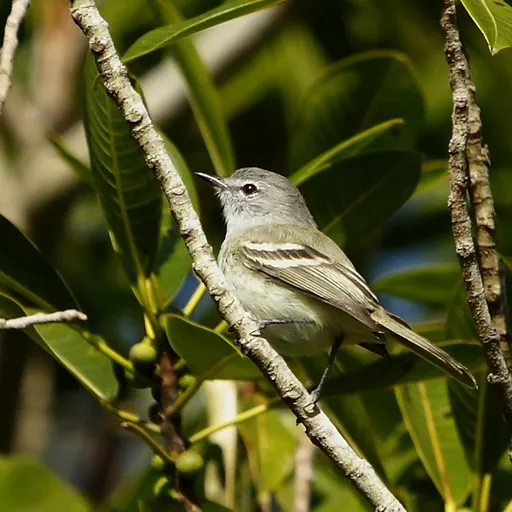
Plain Inezia
Inezia inornata
Least Concern
Overview
The plain inezia, also known as the plain tyrannulet, is a small passerine bird in the family Tyrannidae. It is classified as Least Concern by the IUCN, although its population is believed to be decreasing.
Identification
- Approximately 9 cm long with a weight of 5.5 to 6 g, featuring uniform plumage across both sexes.
- Grayish to olive-gray crown, back, and rump, contrasted by a whitish face with a thin white supercilium and eye-ring.
- Dusky wings displaying two distinct wing bars formed by dull white edges on the inner flight feathers and tips of the wing coverts.
- Song described as a somewhat musical series of thin whistles with an emphatic introductory note, transcribed as 'psee-tee-ee-ee-ee'.
Habitat
Breeding occurs in deciduous and semi-deciduous woodlands and the drier Gran Chaco, ranging in elevation from near sea level to 700 m. The species has a broad range spanning parts of Argentina, Bolivia, Brazil, Paraguay, and Peru, with non-breeding individuals moving to shrubby early successional vegetation along watercourses in northern regions.
Diet
The plain inezia feeds primarily on arthropods and probably also small fruits. It forages alone or in pairs, occasionally joining mixed-species flocks, by gleaning from foliage and twigs while perched or briefly hovering after a short flight.
Did you know?
The species was originally described as Serpophaga inornata before being moved to its present genus Inezia by the late twentieth century.
Sources
- Wikipedia · CC BY-SA 4.0
- Wikidata · CC0 1.0