
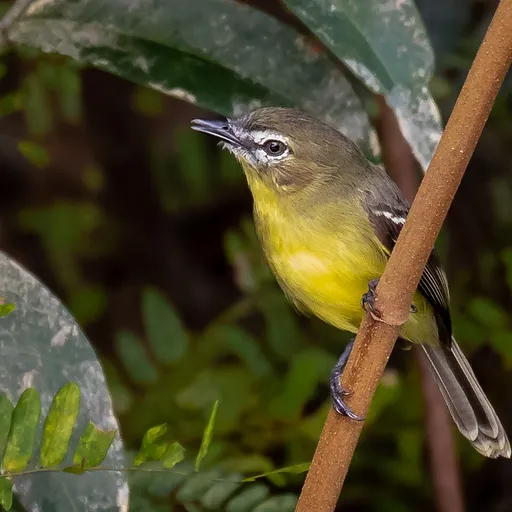
Amazonian Inezia
Inezia subflava
Least Concern
Overview
The Amazonian inezia, or Amazonian tyrannulet, is a species of passerine bird in the family Tyrannidae. It is found in parts of South America, including Bolivia, Brazil, Colombia, and Venezuela, and is currently classified as Least Concern by the IUCN.
Identification
- A small passerine approximately 12 cm long, weighing 7 to 8 g, with a thin black bill and gray to slate legs.
- Adult plumage features a brownish olive to olive crown and back, a wide white supercilium, thin white broken eye-ring, and dusky line through the eye.
- Underparts are pale to bright yellow with whitish chins, often showing a dusky wash on the breast sides resembling a vest.
- Wings are dusky with white outer edges that form two wing bars or rows of spots; the tail is dusky olive with whitish outer edges and tips.
Habitat
This species has a disjunct distribution across the Amazon Basin, typically associated with water in shrubby areas along watercourses, swamp forest, and várzea forest. It ranges in elevation from sea level to about 200 m.
Diet
The Amazonian inezia feeds on arthropods, typically foraging alone or in pairs in dense vegetation 1 to 3 m above the ground. It gleans prey from foliage and twigs while perched and by briefly hovering after short flights, often with its tail cocked up.
Did you know?
Males and females often sing in duet, with the male producing a clear 'pee-chew' double note and the female responding with a rattled 'kit-up' or 'kit-tr-up' note.
Sources
- Wikipedia · CC BY-SA 4.0
- Wikidata · CC0 1.0