
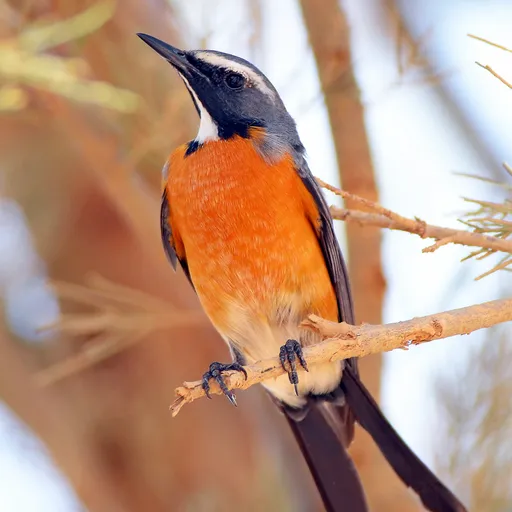
White-throated Robin
Irania gutturalis
Least Concern
Overview
The white-throated robin, also known as the irania, is a small migratory passerine bird and the sole member of the genus Irania. It belongs to the Old World flycatcher family Muscicapidae and is categorised as Least Concern by the IUCN.
Identification
- Size and build: Larger than the European robin, measuring approximately 16 cm in length with a wingspan of 28 cm.
- Male plumage: Features lead-grey upperparts, a black face and tail, a strong black bill, and bright orange underparts with a distinctive white throat patch and supercilium.
- Female plumage: Plainer and duller than males, predominantly grey with a black tail, hints of orange on the flanks, and faint white throat streaks.
- Vocalisation: The male produces a fast twittering song from bushes or in flight, while the call is described as a 'chis-it' double note similar to that of the white wagtail.
Habitat
Breeding populations inhabit dry, rocky high-altitude slopes, typically between 1,000 and 2,200 metres above sea level, dominated by dense scrub, semi-desert, or mountain steppes in western Asia. During winter, the species migrates to East Africa, where it resides in closed thickets within dry Acacia-Commiphora woodland on the central plateau.
Diet
This species is primarily insectivorous, foraging for small invertebrates on the ground or in low vegetation, particularly during the breeding season to support chick development. In autumn, it supplements its diet with fruit.
Did you know?
Despite being a resident of Asia and Africa, this bird is a very rare vagrant to Europe, with recorded observations reaching as far north as Norway and as far west as the United Kingdom.
Sources
- Wikipedia · CC BY-SA 4.0
- Wikidata · CC0 1.0